

A laboratory observation about water isn’t proof that drinking it improves health. That distinction is central to structured water health claims, where findings about water near biological surfaces can sound more conclusive than they are. It’s reasonable to wonder whether water’s behaviour at a microscopic level could matter to the body. Scientific curiosity deserves room, alongside careful questions about what has actually been tested.
This article separates laboratory observations from evidence about health outcomes in people. You’ll learn why studies of water interacting with surfaces or cell components don’t, by themselves, show that drinking a particular kind of water changes hydration or wellbeing. You’ll also find practical ways to recognise when a claim goes further than the research.
The aim isn’t to dismiss an open scientific question. It’s to help you distinguish a measured result from a proposed explanation or health benefit, and make informed choices without pressure.
Key Takeaways
- Separate observations about water’s behaviour in laboratory settings from evidence that drinking it changes health outcomes.
- A 2024 study identified bio-interfacial water at approximately 3% of intracellular water in the cell types examined. It did not test whether drinking structured water affects health.
- Assess structured water health claims by identifying the study and checking what it measured, rather than relying on scientific-sounding language alone.
- Look for research that examines the same water, route of use and health outcome named in a claim.
- Keep an open mind about scientific questions while treating proposed benefits as unestablished unless direct evidence supports them.
Structured water health claims: separate water properties from health outcomes
Descriptions of water interacting with cells can sound compelling, especially when paired with ideas about vitality, hydration or cellular balance. But a striking laboratory observation and a demonstrated health effect are different kinds of evidence. A health claim says that a product affects health. Describing a water property, such as its pH or proposed molecular arrangement, doesn’t establish that effect.
What does ‘structured water’ mean in these claims?
“Structured water” is used to describe proposed arrangements or properties of water, but it doesn’t refer to one universally accepted structure. Some discussions draw on exclusion-zone research, which examines water near hydrophilic, or water-attracting, surfaces in laboratory settings. Researchers have observed that certain particles are excluded from areas close to these surfaces. The observation and its proposed explanations are not the same as evidence of a health benefit. The Hexagonal water entry outlines why claims about stable, hexagonal arrangements are disputed. A summary of that debate is not evidence that drinking such water produces a health benefit.
Why are health claims a separate question?
A controlled experiment near a surface measures what happens in that particular set-up. To establish an effect on people, research would need to test the relevant water in people and measure the specific health outcome being claimed. A laboratory model can suggest a question for further study, but it can’t stand in for that study. A model of water at a surface also doesn’t automatically describe what happens after someone drinks the water.
The distinction matters when scientific language shifts from describing a property to promising an outcome. Source Water describes its water as naturally structured and reports a measured pH of 9.5. That is a product property, not evidence that the water treats, prevents or improves a health condition. Descriptions involving charge or cellular conditions likewise don’t establish that drinking the water changes cells or delivers a medical benefit.
A proposed mechanism does not establish a health benefit. When assessing structured water health claims, ask whether the evidence measures a water property, a process in a laboratory model, or an outcome in people. These findings may inform different questions, but they aren’t interchangeable.
What structured water research has examined, and what it has not
Some research discussed in relation to structured water focuses on what happens at the boundary between water and a hydrophilic surface, a material that attracts water. In experiments associated with Gerald Pollack’s work, researchers observed a nearby region from which certain particles were excluded. This is a specific physical observation made under controlled conditions. It isn’t a test of whether drinking water described as structured affects health.
What exclusion-zone experiments observe
In simple terms, an “exclusion zone” is an area close to a water-attracting surface where some particles are less present than in the surrounding liquid. These observations are sometimes discussed as support for a proposed “fourth phase” of water, but they don’t settle what causes the particle exclusion. The mechanism remains a question for scientific investigation.
The experimental conditions matter. Results relate to particular surfaces and laboratory arrangements, not every kind of water or every environment in the body. A finding in one set-up may help researchers ask further questions, but it shouldn’t be generalised beyond the conditions examined.
What these experiments cannot answer about drinking water
A surface experiment doesn’t show what happens after a person drinks a particular water. It doesn’t measure how that water is absorbed, whether it changes hydration, or whether it affects a health outcome. Those questions require research designed to study people, the water they consume and the specific outcomes being claimed.
This distinction matters because a proposed explanation can sound like a proven biological effect when it moves from a laboratory description into wellness language. Observing particle exclusion is not, by itself, evidence that the same process occurs throughout the body or that drinking water leads to cellular or medical benefits. A general overview from Healthline similarly notes no evidence to back up these benefits among popular claims about structured water.
A laboratory observation describes what happened in a particular experiment; a human health result shows what happened to people. This distinction helps reveal whether a cited study tested the outcome being suggested, or whether the claim has travelled beyond the research.
Readers curious about Source’s product can explore its naturally structured drinking water as a product description, separate from claims about health outcomes.
What the 2024 study of water inside cells actually found
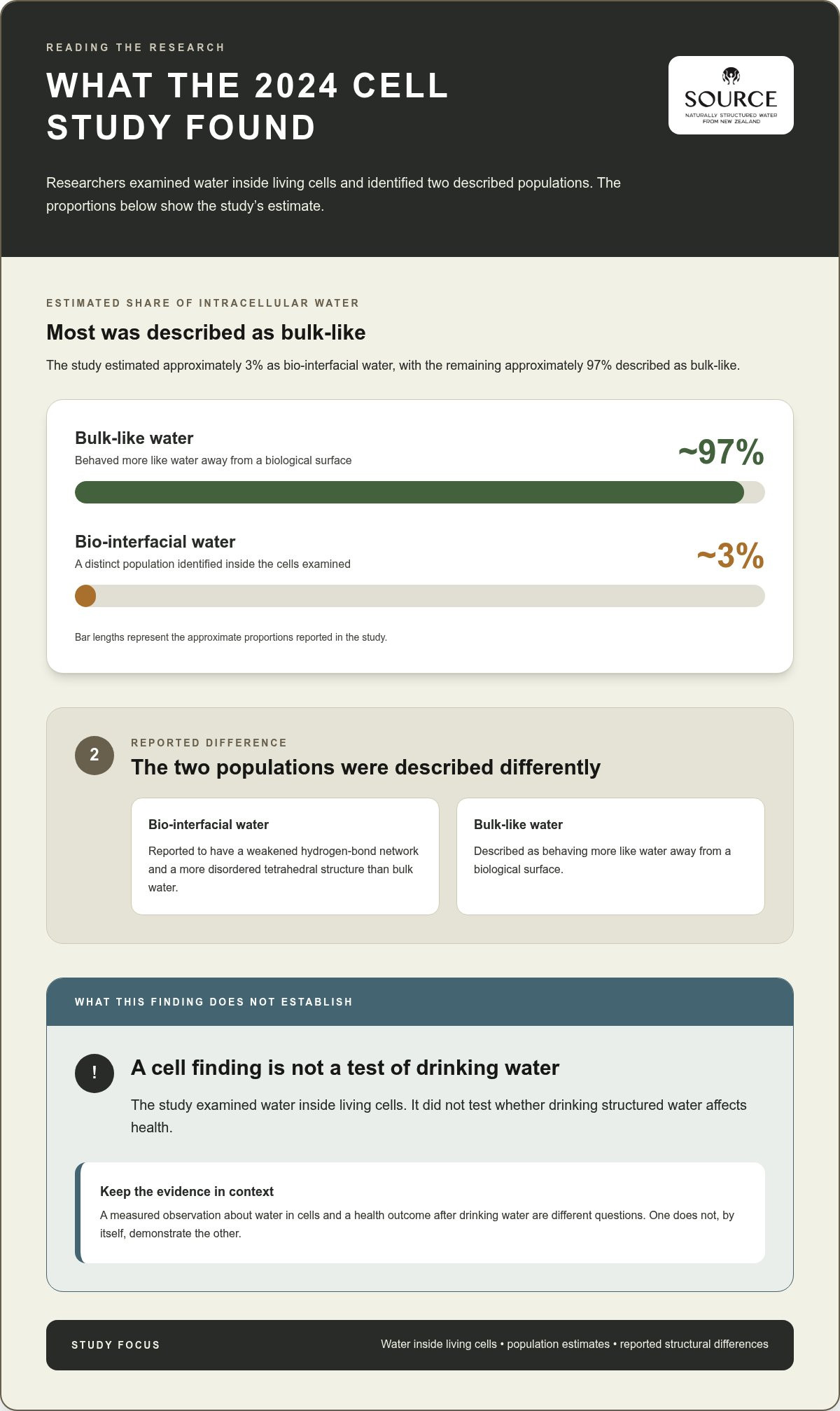
A 2024 study in Nature Communications examined water inside living cells. The researchers identified a distinct bio-interfacial water population, estimated at ~3% of total intracellular water. The remaining ~97% was described as bulk-like, meaning it behaved more like water away from a biological surface. The study reported that the bio-interfacial water had a weakened hydrogen-bond network and a more disordered tetrahedral structure than bulk water.
The study was “Probing the structure of water in individual living cells” by Xiaoqi Lang, Lixue Shi, Zhilun Zhao and Wei Min, published in Nature Communications, 2024, Volume 15, Article 5271 (DOI 10.1038/s41467-024-49404-9). Its findings help describe water environments inside the cells examined. They don’t show that most cellular water is in a special ordered state, or that drinking water described as structured changes the water inside a person’s cells.
What bio-interfacial water means in this study
“Bio-interfacial water” was the term used for water near biological molecules that behaved differently from bulk-like water. On average, soluble proteins inside the cells were surrounded by one full molecular layer (≈ 2.6 Å) of bio-interfacial water. This is a thin layer next to proteins, not a description of a large volume of water throughout a cell.
The scale matters. A local layer next to a protein is not equivalent to saying that all water in a cell, or all water in the body, has the same arrangement. The study’s terminology describes what was examined in its experimental context; it shouldn’t be treated as a universal description of every cell or organism.
Which cells were examined, and why scope matters
The researchers examined HeLa cells, RAW 264.7 macrophages and HT22 neuronal cells. These cell types define the scope of the work. Although studying water in cells can help researchers understand how water behaves around biological structures, the study did not test people drinking structured water.
That means it cannot establish whether consuming a particular water changes hydration, affects health or produces a clinical benefit. Those questions require research designed to measure those outcomes in people. Nor should findings from these three cell types be assumed to apply to unstudied cells or organisms without supporting evidence.
For assessing structured water health claims, distinguish a measured feature inside examined cells from a health outcome after drinking water. The study contributes to scientific understanding of water near proteins. It doesn’t show that a product’s described properties reproduce that cellular environment, or that drinking it leads to a health effect.
The study was supported by the Multi-University Research Initiative of the Air Force Office of Scientific Research (FA9550-21-1-0170) and the National Institute of Health (R35 GM149256). The authors declare no competing interests. This article is licensed under a Creative Commons Attribution 4.0 International License. © 2024 The Authors. Published under the terms of the Creative Commons Attribution 4.0 International License.
Which structured water health claims go beyond the evidence?
Claims about cellular vitality, improved hydration or disease prevention need evidence that directly measures those outcomes in people. The laboratory findings discussed here examine water behaviour near surfaces and water in particular cell types. They did not test Source Water or measure clinical outcomes after people drank it. A plausible explanation or product description isn’t the same as a demonstrated health effect.
| Claim | Evidence type | What remains unestablished |
|---|---|---|
| Structured water improves hydration | Laboratory observations about water properties | Whether drinking the water improves hydration compared with other drinking water |
| Structured water supports cellular vitality | Research on water near surfaces or in specific examined cells | Whether drinking it changes cell function or improves vitality in people |
| Structured water treats or prevents disease | No disease outcomes were tested in the laboratory and cell findings discussed here | Any treatment or preventive effect in people |
Does research prove structured water improves human health?
No. The findings discussed here don’t prove health benefits from drinking Source Water. They describe observations in laboratory settings and examined cells, not outcomes in people who consumed a particular water. To support a claim about hydration, for example, research would need to measure hydration in people under relevant conditions. To support a claim about disease, it would need to investigate that specific outcome directly.
The findings discussed here do not establish treatment or prevention of disease. That doesn’t prove either benefit or harm; it means the evidence doesn’t answer those questions. Keeping the distinction clear helps prevent an early scientific observation from being mistaken for a health result.
Can pH or a proposed charge prove a health benefit?
Source Water reports a measured pH of 9.5. This is a measured product characteristic, not evidence of a medical outcome. Likewise, describing water in terms of a proposed charge or structure doesn’t, by itself, show that drinking it changes hydration, cellular function or wellbeing. A product property and a health outcome are different things, and evidence for one doesn’t automatically establish the other.
When reading structured water health claims, look for research that tests the same water, the same way of using it and the specific outcome being claimed. If you’re interested in the product itself, you can explore Source Water’s naturally structured drinking water separately from unestablished health outcomes.
How to assess structured water health claims with care
A careful evidence check can help separate a promising idea from a result that has been demonstrated. For structured water health claims, take the statement one step at a time:
- Identify the claim. Is it describing a water property, or promising an effect on hydration, cellular vitality or health?
- Identify the evidence. Is the source reporting a laboratory observation, a personal account or a study measuring health outcomes in people?
- Check what was measured. Does the research examine the same water, route of use and outcome named in the claim?
These questions matter because evidence can become stretched as it moves from a laboratory observation to a wellness promise. An experiment on water near a surface doesn’t test what happens after someone drinks that water. A study of one product or cell model also can’t automatically establish an effect for another product or for people.
A practical evidence check for wellness claims
Look for the study itself, then compare its methods and results with the wording of the claim. Personal stories can describe an individual’s experience, but they can’t show on their own that a product caused an effect or that the same outcome will happen for others. Notice when a proposed mechanism is presented as though it were a measured health result. A careful claim should stay within the limits of the evidence.
A measured next step for readers exploring Source
Source is a New Zealand water company offering drinking water drawn from an aquifer. The company reports a measured pH of 9.5. These details describe the product; they aren’t proof of medical or cellular benefits. Readers who’d like to understand the product description can explore the guide Buy Structured Water Online: A Considered Guide to Source Water.
Source orders are placed online, with shipping throughout New Zealand and to many countries across Europe, North America, Asia and Africa. Product information tells you how the water is described, while health outcomes require evidence that directly tests them. Keeping those separate allows curiosity and discernment to sit together, without treating a possibility as proof.
Stay curious, and let the evidence guide you
The clearest way to assess structured water health claims is to separate what researchers observe from what they measure in people. Findings about water near surfaces or within particular cell types can inform further questions, but they don’t establish that drinking a particular water improves health. Look for evidence that tests the same water, route of use and outcome described in a claim.
Source is a New Zealand water company offering naturally structured drinking water from an aquifer. Its product information reports a measured pH of 9.5, a water characteristic rather than proof of a health effect. Keeping that distinction in view makes space for scientific curiosity and thoughtful choices, without asking research findings to promise more than they show.
To explore the product details and order online, visit Source’s water information. Source ships throughout New Zealand and internationally.
Frequently Asked Questions
Can research prove that drinking structured water improves health?
No. The research discussed here describes laboratory observations near surfaces and water in specific cell types, not clinical evidence that drinking Source Water improves health or treats a condition. These findings may be scientifically interesting, but they don’t establish a human health benefit. When considering structured water health claims, check whether the research measured the outcome being promised. A proposed mechanism is not proof that an effect occurs in people.
What did the 2024 study find about water inside cells?
The 2024 Nature Communications study identified a distinct population it called bio-interfacial water, estimated at ~3% of total intracellular water. It described the remaining ~97% as bulk-like water. The researchers examined HeLa, RAW 264.7 macrophages and HT22 neuronal cells. These findings describe water in the cells studied; they don’t show that drinking structured water changes health outcomes.
Is exclusion-zone research evidence that structured water benefits people?
No, not by itself. The research discussed here describes regions observed near particular hydrophilic, or water-attracting, surfaces under experimental conditions. That observation doesn’t test what happens after someone drinks a particular water or measure a health outcome. Treat the finding within its laboratory context. A proposed explanation for the observed region should not be presented as a confirmed mechanism or a demonstrated benefit to people.
Does Source Water’s pH prove that it has health benefits?
No. Source Water’s product information reports a measured pH of 9.5. This is a product characteristic, not proof of a medical benefit. A pH measurement alone doesn’t establish treatment or prevention of disease, or improved cellular health. You can consider the stated product information while keeping it separate from evidence about health outcomes in people.
Are personal stories about Source Water the same as clinical evidence?
No. A personal story records one person’s reported experience, but it can’t establish what caused that experience or whether others would have the same outcome. Personal accounts should be presented as individual reports, not as evidence that Source Water treats, cures or prevents a condition.
How can I assess a structured water health claim?
Start by identifying the exact outcome being claimed, then find out what the cited research measured. Ask whether it studied people drinking the same water and assessed that particular outcome, or instead examined a laboratory model or water near a surface. Keep product properties and proposed explanations distinct from demonstrated health results. This simple check can help you stay open to scientific questions without treating possibility as proof.