

What if water for cellular hydration is less about finding a special kind of water and more about the body’s careful balance of fluids and electrolytes? The phrase can sound as though a particular drink carries water straight into your cells, yet hydration is a coordinated process involving the gut, bloodstream and cell membranes.
It’s understandable to wonder whether the water you choose changes how well your cells are hydrated. With different explanations and wellness claims in circulation, it can be hard to separate established physiology from ideas that are still being explored.
This article explains what cellular hydration means, how water moves between the body’s fluid compartments, and how electrolytes such as sodium and potassium help regulate that movement. It also offers a practical way to assess claims about structured water, without assuming that a particular water choice has proven cellular benefits.
Key Takeaways
- Understand what water for cellular hydration means, and how it differs from simply drinking water.
- See how osmosis and electrolytes help regulate the movement of water across cell membranes.
- Learn why the body’s fluid-balance processes do not establish that structured water hydrates cells better than other drinking water.
- Explore simple hydration habits, including keeping water nearby, drinking with meals and responding to thirst.
- Consider Source Water as one drinking-water choice, distinct from the body’s fluid-balance processes. Order online, with shipping throughout New Zealand and to many countries worldwide.
What does cellular hydration mean for water inside your cells?
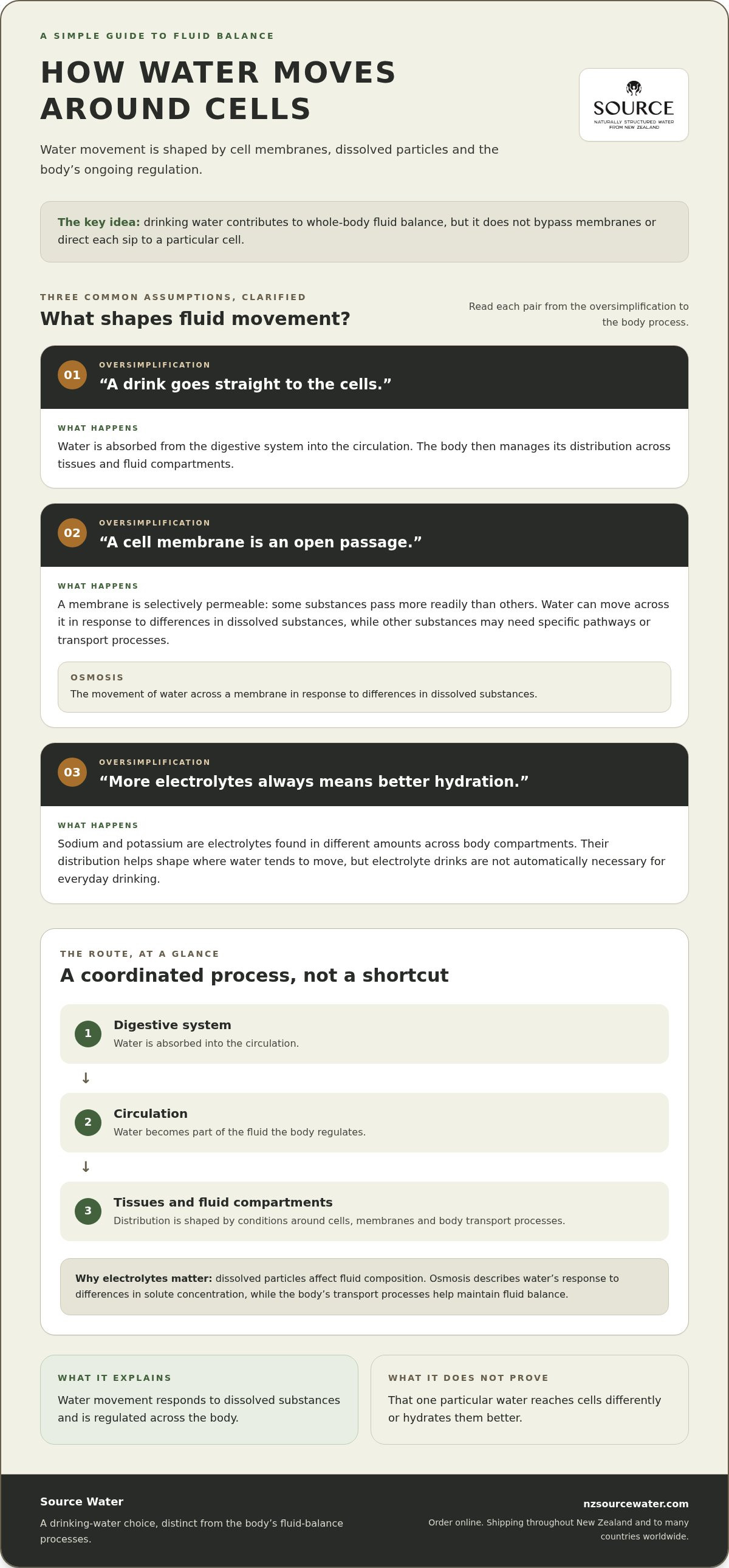
Cellular hydration describes the balance of water within cells and in the fluid around them. It’s part of the body’s wider regulation of water, not a separate destination that a drink can guarantee. Water you consume is absorbed from the digestive system into the circulation, then the body manages its distribution across tissues and fluid compartments.
Cellular hydration is the balance of water inside and around cells, maintained as part of whole-body fluid regulation. This is more precise than marketing language that suggests a special water can travel directly to cells or produce a particular cellular result. The phrase water for cellular hydration describes an area of interest, but it isn’t proof that one type of water reaches cells differently or hydrates them better.
How does water relate to cell structure?
Cells contain water, which forms part of the environment where their internal processes take place. Around each cell is a membrane: a flexible boundary that separates the inside from the surrounding fluid while allowing substances, including water, to move in regulated ways. The membrane isn’t a sealed wall, and water doesn’t simply enter every cell in response to thirst.
Imagine a cell as a room with a doorway that opens according to the conditions on either side. The comparison helps show that movement is regulated, but it has limits: a membrane is not a door, and the body’s fluid balance depends on biological processes rather than a person consciously opening or closing a passage. One relevant process is osmosis, the movement of water across a membrane in response to differences in dissolved substances.
Is cellular hydration separate from ordinary hydration?
No. Cellular hydration is one part of whole-body hydration. Drinking water contributes to the body’s overall fluid balance, and ordinary drinking water can support normal hydration. But a glass of water doesn’t provide a simple, guaranteed measure of what is happening inside any individual cell. The body continuously regulates fluid distribution rather than directing each sip to a chosen place.
Thirst can prompt you to drink, while fluid intake is one part of the broader picture. Neither tells you exactly how much water is inside a particular cell. Expressions such as “absorbs faster” or “gets into cells” may make cellular hydration sound like a direct, measurable effect of choosing a particular drink. A description of water moving across membranes explains physiology; it doesn’t show that a specific water product changes that process.
Think of hydration as a coordinated balance across the body, with cells included. It isn’t a special drinking target separate from ordinary hydration, and the phrase alone doesn’t establish that one water choice offers a cellular advantage.
How do water, osmosis and electrolytes move around cells?
Water moves through the body across several fluid spaces, including the fluid inside cells and the fluid surrounding them. Its movement is influenced by dissolved substances, or solutes, on either side of a cell membrane. Water movement across membranes depends on the membrane’s selective permeability and the concentration of solutes on either side, while the body’s transport processes help maintain fluid balance.
What role do cell membranes play in water movement?
A cell membrane is a selectively permeable boundary. It allows some substances to pass more readily than others, so it isn’t an open channel through which water can flow without regulation. Water can move across the membrane in response to differences in solute concentration, while other substances may need specific pathways or transport processes to cross.
Picture two connected spaces separated by a fine barrier. If one space contains more dissolved particles that can’t readily pass through, water tends to move towards that side. This is osmosis. The comparison is a useful starting point, but cells are not simple containers: their membranes and transport systems shape the conditions on both sides.
In the body, water may shift between fluid compartments as their composition changes. After water enters the circulation from the digestive system, it becomes part of the fluid the body regulates and distributes. The direction and extent of movement depend on the conditions around cells, not simply on the type of water someone has drunk. A water choice doesn’t bypass membrane function or the body’s regulation.
Why do electrolytes matter to fluid balance?
Electrolytes are minerals that form electrically charged particles when dissolved in fluid. Sodium and potassium are two examples. They’re present in different amounts in different body compartments, and their distribution helps shape where water tends to move. Cells and tissues also use transport processes to maintain these differences, so fluid balance is more than water following a simple, fixed path.
Dissolved particles affect the composition of a fluid. Inside the body, electrolytes contribute to differences in solute concentration across cell membranes. Osmosis describes water’s response to those differences, but it doesn’t mean that adding more electrolytes will always improve hydration. The body’s needs and surrounding conditions matter, and electrolyte drinks are not automatically necessary for everyday drinking.
This is why water for cellular hydration is best understood through fluid balance, rather than as a promise that a particular water will enter cells more quickly. The mechanism involves membranes, solutes and the body’s ongoing regulation.
If you’re choosing drinking water as part of your daily routine, you can explore Source Water as one option, without assuming that a water choice changes these established processes.
Does a particular type of water hydrate cells better?
It’s natural to wonder whether water described as structured, alkaline or specially arranged behaves differently after you drink it. The body’s established fluid-balance processes offer a useful starting point, but they don’t establish that one category of drinking water hydrates cells better than another.
What is established about water and cellular fluid balance?
Water from drinks contributes to the body’s overall fluid balance. After it’s absorbed from the digestive system, water becomes part of the fluid the body regulates and distributes. Cell membranes, differences in dissolved substances and the body’s transport processes all help determine how water moves between compartments. This is a coordinated biological process, not simply a matter of a drink being labelled for cellular hydration.
Evidence that drinking fluids supports hydration does not, by itself, show that a particular water category offers an advantage. To establish superiority, research would need to compare specific waters and measure relevant outcomes directly. General explanations of osmosis or hydration aren’t substitutes for that kind of comparison.
Water movement depends on the body’s membranes, fluid conditions and regulation; a product description alone doesn’t demonstrate faster absorption or improved cellular hydration. That distinction helps keep accepted physiology separate from claims about specialised water. The phrase water for cellular hydration may describe a consumer interest, but it isn’t evidence that one drink reaches individual cells by a different route.
How should readers assess structured-water explanations?
Separate what a statement describes from what it demonstrates. “Naturally structured” describes how a product is presented. “Absorbs faster” or “improves cellular hydration” makes a claim about what happens in the body. That second kind of statement needs relevant human evidence, not just an explanation of water’s molecular behaviour or movement in a laboratory setting. Laboratory observations may raise questions for further study, but they don’t automatically show that drinking a product produces the same effect in people.
Source Water describes its drinking water as naturally structured and alkaline, with a measured pH of 9.5. These are product characteristics, not proof of a medical benefit or a cellular hydration advantage. pH describes how acidic or alkaline a liquid is; the number alone doesn’t show that water crosses cell membranes faster. The word “structured” also doesn’t establish a distinct effect after drinking.
When assessing a claim, ask: Is this a description of the water, a proposed explanation, or an outcome demonstrated in people? Is the claim about general hydration, or specifically about cells? This distinction lets you consider different water choices with curiosity while keeping conclusions proportionate to the evidence. A structured-water description should not be treated as proof of superior cellular hydration.
What practical habits support everyday hydration?
Everyday hydration can be supported by steady, flexible habits rather than a strict target or a special formula. Keep drinking water within reach, have some with meals, and pay attention to thirst as part of your usual routine. Water for cellular hydration isn’t a separate daily task: the practical focus is supporting overall fluid intake in ways that fit your day.
Food and other drinks can contribute to overall fluid intake too. A meal, a cup of tea or a glass of water may all form part of someone’s usual pattern. There’s no need to turn every drink into a calculation. People’s circumstances differ, so a single daily volume won’t suit everyone.
How can you build a simple hydration routine?
Linking a drink to familiar moments can make the habit easier to remember. You might have water with breakfast, keep a glass nearby while working, or drink with lunch. Notice when thirst arises and how your routine fits around meals and activities. These are general habits, not a way to diagnose dehydration or assess what is happening inside individual cells.
- Keep water somewhere convenient, such as on your desk or in your bag.
- Pair a glass of water with a regular meal or break.
- Include water-rich foods and other fluids in your usual routine.
A practical summary: make water accessible, drink with meals, and let thirst and your daily circumstances guide a flexible routine.
When might hydration needs differ?
Fluid needs can vary with the environment, activity and personal circumstances. A warm day, time spent being active, or a change in routine may affect how much someone wants to drink. These factors are a reminder to avoid treating one number as a universal prescription. This general explainer can’t provide individualised health advice.
If you have a health concern or have been given specific guidance about fluids, speak with an appropriate health professional about what suits you. General hydration suggestions aren’t a substitute for advice tailored to your circumstances.
For an everyday water choice, you can order Source Water online. Source Water is a New Zealand water company that ships throughout New Zealand and to many countries worldwide. Choosing a water is a personal preference, not a promise of a particular cellular outcome.
How does Source Water fit into a mindful hydration routine?
A mindful hydration routine can include a water you choose and enjoy, while keeping product descriptions distinct from established explanations of fluid balance. Source Water offers naturally structured drinking water. That description tells you how the product is presented, but it doesn’t establish that it moves into cells differently or changes the body’s fluid regulation.
What can the product description tell readers?
The product is described as naturally structured and alkaline, with a measured pH of 9.5. These are characteristics of the water, not evidence of faster absorption, changes to cell function or treatment of a health condition.
Distinguish a description of a product from a claim about what happens after drinking it. The first tells you about the water; the second needs relevant evidence about outcomes in people. Neither the term “naturally structured” nor a pH value alone demonstrates a cellular hydration advantage.
How can readers explore Source Water?
You can consider Source Water as one personal water choice without treating its product description as a medical promise. As you reflect on what suits your routine, keep preference separate from evidence: a product may appeal to you, while claims about cellular outcomes still require appropriate support.
Let your choice be guided by curiosity and clear information, rather than an assumption that any particular water offers a shortcut to cellular hydration. If naturally structured drinking water interests you, explore Source Water and decide whether it suits your everyday routine.
Choose your next step with clarity
Let curiosity guide your water choices, while keeping a clear line between a product’s description and evidence of what happens in the body. The idea of water for cellular hydration can prompt useful questions, but it doesn’t mean a particular water has been shown to produce a special cellular effect. A mindful routine can begin with a simple choice that suits your preferences and is easy to make part of everyday life.
If you’d like to explore naturally structured drinking water, discover Source Water. The product description helps you understand the offering; it isn’t a promise of a medical outcome or cellular advantage. You can explore Source Water online and consider whether it suits your routine.
Approach hydration with steady attention rather than pressure to find a shortcut. A thoughtful choice that works for you can be part of your daily routine.
Frequently Asked Questions
What is cellular hydration?
Cellular hydration refers to the water balance within cells and in the fluid surrounding them. It’s one part of the body’s overall fluid balance, rather than a separate target measured by choosing a particular drink. The phrase water for cellular hydration describes this topic, but it doesn’t mean water is directed to individual cells on demand or that a specific product has a proven cellular effect.
Can drinking water hydrate your cells?
Yes, drinking water contributes to the fluid available for the body to regulate, including fluid around and within cells. The water is absorbed through the digestive system, then distributed as part of normal body processes. That doesn’t mean each glass can be traced to particular cells or guarantees a specific cellular outcome. Food and other drinks can also contribute to overall fluid intake, so consider your usual pattern rather than one drink in isolation.
How does water move through a cell membrane?
Water can cross cell membranes through pathways in the membrane, with movement influenced by differences in dissolved particles on either side. This movement is part of osmosis, but the membrane also controls the passage of other substances, and cells have transport processes that help maintain their internal conditions. So the membrane isn’t simply an open doorway. The direction of water movement depends on the surrounding conditions, not only on what you drink.
Do electrolytes help with cellular hydration?
Electrolytes such as sodium and potassium are dissolved particles that contribute to fluid balance and help shape how water is distributed across body compartments. They have important roles in normal body processes, but that doesn’t mean extra electrolytes are always needed or that adding them to a drink automatically improves hydration. For everyday choices, avoid assuming that an electrolyte product is necessary just because it is marketed for cellular hydration.
Is structured water proven to hydrate cells better?
Current evidence does not establish that drinking structured water hydrates cells better than other drinking water. Some laboratory research examines how water behaves near certain surfaces, but that observation alone can’t show what happens after someone drinks a product. To demonstrate a difference in people, research would need to test the specific water and measure relevant outcomes. Treat “structured” as a product description, not proof of a cellular advantage.
How much water should I drink for cellular hydration?
There isn’t one volume that suits everyone, and “cellular hydration” doesn’t create a separate daily water target. Fluid needs can vary with activity, surroundings and personal circumstances; food and other drinks contribute too. Rather than trying to calculate water for individual cells, build a routine that fits your day and notice thirst. If you have a health concern or personalised fluid guidance, speak with an appropriate health professional.
Does alkaline water have a different effect on cellular hydration?
A water’s alkaline description or pH value doesn’t, by itself, demonstrate that it hydrates cells differently. The body regulates its internal fluid conditions through biological processes, so a product characteristic shouldn’t be treated as evidence of faster absorption or a cellular benefit. If comparing alkaline water with other choices, distinguish measurable product details from outcomes shown in people. Preference may guide your choice, but it isn’t proof of a physiological difference.