

What if the most intriguing claims about water are also the ones that need the clearest boundaries? Gerald Pollack water research has drawn attention to exclusion zones, or EZs: regions observed beside certain surfaces where particles are absent. The idea can sound like evidence of a new, universal form of water, yet the experiments describe what happened under particular laboratory conditions, not what every glass of drinking water contains.
Scientific language and popular explanations can make the distinction difficult to follow. This article explains EZ water in accessible terms, outlines what researchers measured and how experimental conditions shaped their observations, and separates those findings from broader interpretations and product claims. We’ll look at a reported experiment in which infrared exposure enlarged an exclusion zone, then consider what that result can and can’t establish. The aim is a grounded view of Gerald Pollack’s work, including where the evidence stops and why laboratory findings alone don’t show that drinking water shares the same properties.
Key Takeaways
- Learn how researchers use “exclusion zone” to describe regions near hydrophilic surfaces where particles or solutes are excluded in particular experimental setups.
- See what Chai, Yoo and Pollack measured in their radiant-energy study, and why the observed changes depended on wavelength.
- Compare polymer-gel results across different materials and microsphere configurations, including a reported upper range of approximately 0.25 mm.
- Use a simple evidence check: identify the setup, measurement, result and interpretation before drawing conclusions about Gerald Pollack water.
- Keep laboratory findings separate from drinking-water claims: the cited studies don’t establish that Source Water shares EZ properties, while its measured pH is 9.5.
What does “Gerald Pollack water” mean? A plain-English introduction to EZ water
“Gerald Pollack water” is a search phrase people use to find research associated with bioengineer Gerald Pollack. It isn’t a confirmed standard product category. In this research, exclusion zone, or EZ, describes a region observed beside certain water-attracting surfaces, where suspended particles or dissolved substances were absent or reduced in the experimental setup.
The distinction matters: seeing a particle-free region is an observation; explaining what the water is doing there is a further interpretation. The term “EZ water” is sometimes used for the water in that region, but the label alone doesn’t establish that it is a separate, universal phase found in every kind of water. A neutral introduction to the topic, including its history and proposed models, is available in this overview of Exclusion zone (EZ) water.
What is an exclusion zone in Pollack’s research?
Picture tiny microspheres suspended in water beside a surface. If the spheres are observed to stay away from the surface, the space between them may appear as a clear band. Researchers describe that particle-poor region as an exclusion zone. A hydrophilic surface interacts readily with water, much as a surface that wets easily does. Nafion and polymer gels were among the experimental surfaces used in the studies discussed here.
Is EZ water a measured finding or an explanation?
The measured finding is the distribution of particles or solutes under particular conditions: where they were present, where they were excluded, and how the region changed. The idea that water molecules form a distinct, highly ordered layer is an explanation proposed to account for such observations, not the observation itself.
That distinction makes the evidence easier to assess. A visible particle-free band doesn’t, by itself, reveal the molecular arrangement of the water or prove why the particles moved or remained outside it. In the polymer-gel study, the mechanism behind the observed exclusion remained unresolved. Researchers have proposed models for how these zones might form, but the experiments discussed here don’t establish one explanation as universal or settled.
In plain English, EZ water is best approached as a research term tied to specific observations near particular surfaces. The findings invite further investigation, while proposed mechanisms remain questions to examine rather than conclusions to assume.
What Pollack’s radiant-energy experiment measured near hydrophilic surfaces
In “Effect of Radiant Energy on Near-Surface Water”, Chai, Yoo and Pollack examined whether radiant energy affected the size of exclusion zones beside a hydrophilic surface. They tracked the particle-free region under different exposure conditions. The study reported that the zones expanded during exposure, with the observed change depending on wavelength.
How the reported infrared result was measured
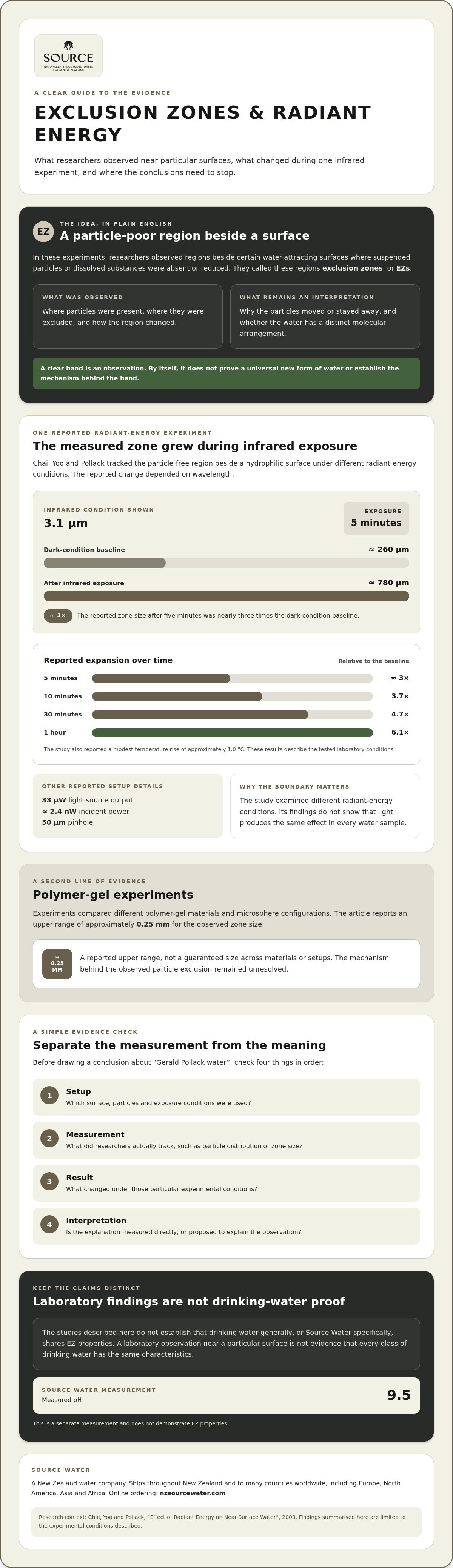
For one experiment, the researchers used infrared light at 3.1 µm. The light source had a reported output of 33 µW, while the incident power was approximately 2.4 nW. A 50 µm pinhole was used in the optical arrangement. Under dark conditions, the baseline exclusion zone was approximately 260 µm; after five minutes of exposure, it measured approximately 780 µm.
This experiment reported a near threefold increase in exclusion-zone size after five minutes of exposure to 3.1 µm infrared light.
The authors also reported expansion ratios of 3.7 × after 10 minutes, 4.7 × after 30 minutes and 6.1 × after one hour. These observations come from a specific laboratory setup, not evidence that radiant energy will produce the same effect in every water sample. Wavelength matters too. The study examined how zone size changed under different radiant-energy conditions, so the finding shouldn’t be simplified to “light expands EZs” without qualification.
The study was published by Binghua Chai, Hyok Yoo and Gerald H. Pollack in Journal of Physical Chemistry B, 2009, Volume 113, Issue 42, Pages 13953-13958 (DOI 10.1021/jp908163w). Correspondence: ghp@u.washington.edu; Tel.: (206) 685-1880; Fax: (206) 685-3300. Funding: NIH Grants AT-002362 and AR-44813; Office of Naval Research Grant N00014-05-1-0773.
What the temperature readings do and don’t show
Temperature readings rose modestly, by approximately 1.0 °C. The reported increases were 1.1 °C, 0.91 °C, 0.92 °C, 0.91 °C and 0.92 °C across the measured positions. The authors linked EZ expansion to incident radiant energy rather than to a rise in bulk water temperature.
That interpretation is narrower than a claim that heating caused the zones to grow. It describes how the authors understood their measurements, while leaving the underlying mechanism open to further investigation. The experiment records a change near a surface under controlled conditions; it doesn’t establish that drinking water generally forms larger exclusion zones when exposed to infrared light.
This is one reason to keep the laboratory result distinct from product information. For a separate look at drinking water from a New Zealand aquifer, you can read about New Zealand drinking water. That information doesn’t mean the cited experiment measured or established the properties of that water.
How polymer-gel experiments compare: zone size, particles and limits
The study “Long-range forces extending from polymer-gel surfaces” examined exclusion zones beside polymer gels using suspended microspheres. Its measurements show why there isn’t one fixed width to attach to an EZ: the observed distance varied with the gel, experimental arrangement and particles used to mark the zone.
Measured zone dimensions varied with the experimental setup. The study reported widths of about 100 µm in a sandwich configuration and about 60 µm in a cylindrical-channel configuration. With polyHEMA gel, zones reached up to approximately 120 µm for amidine microspheres. A separate pairing of rabbit-psoas muscle gel and carboxylate microspheres produced a zone of about 80 µm.
Across the study’s reported observations, the upper range extended to approximately 0.25 mm. That figure is an experimental maximum, not a standard EZ size or a dimension that should be expected beside every hydrophilic surface. The specific measurements are most useful when read alongside the materials and configurations used.
How particles and solution conditions shaped the results
The type of microsphere mattered. In the radiant-energy study discussed in the previous section, researchers also reported that microsphere size and composition affected the observations. In the polymer-gel experiments, amidine and carboxylate microspheres did not respond identically to changes in pH: the reported effects differed between the two particle types. This cautions against treating “particle exclusion” as a single result independent of what the particles are made of.
Adding sodium chloride (NaCl) reduced zone size in the polymer-gel experiments. For carboxylate microspheres, the reduction was modest even at 100 mM NaCl. Zone size increased as microsphere diameter increased. Within the practical concentration range studied, changing microsphere concentration had virtually no effect on zone size.
These details matter because the microspheres were the visible markers used to assess the particle-poor region. A change in their size, composition or surrounding solution can influence the measured boundary, so a zone’s dimensions shouldn’t be interpreted without considering the method. The results compare defined laboratory conditions, not a universal measurement for Gerald Pollack water or drinking water more generally.
How to assess claims about Gerald Pollack water without overreading the studies
A useful way to read claims about Gerald Pollack water is to follow the evidence from the laboratory arrangement to the conclusion being drawn. This keeps a measured observation distinct from an explanation of why it occurred, and from claims that extend beyond the experiment.
- Setup: What surface, particles, solution and exposure conditions did researchers use?
- Measurement: Did they observe particle exclusion, measure a zone’s dimensions, or assess another property?
- Result: What changed under those specific conditions?
- Interpretation: Which parts are measured findings, and which are the authors’ proposed explanation?
That sequence matters because the radiant-energy study examined zones near hydrophilic surfaces under tested wavelengths, while the polymer-gel study reported results for particular gels, microspheres and configurations. In the radiant-energy paper, the authors discussed a battery-like model to help explain their observations. It’s a proposed mechanism, not a direct measurement of a universal water structure or settled proof of how all exclusion zones form.
Where the evidence stops
Microsphere exclusion tells researchers that particles were absent from a region in a given experiment. It doesn’t directly measure drinking-water benefits, hydration effects or medical outcomes. Nor do observations beside Nafion or polymer-gel surfaces, by themselves, establish the properties of packaged water. The experimental material, surrounding conditions and method all matter.
These studies don’t prove that all water contains a distinct, structured phase. They also don’t show that water from a particular aquifer has the same measured properties as an experimental exclusion zone. For example, Source Water is reported as measured at pH 9.5, but the cited Pollack studies don’t establish that it forms EZs or shares their experimental characteristics. That pH measurement is separate product information, not a result of the EZ experiments.
Keeping these boundaries clear doesn’t diminish the research. It lets the observations stand on their own terms, without turning them into treatment, health or hydration claims the experiments weren’t designed to test.
For separate product details, view information about New Zealand aquifer water, including its reported pH measurement.
Gerald Pollack water research and Source Water: keeping the distinction clear
Laboratory observations near a hydrophilic surface and information about drinking water answer different questions. The Gerald Pollack water studies discussed here examined exclusion zones under defined experimental conditions. They do not establish the properties of Source Water, show that it forms an exclusion zone, or demonstrate that it reproduces the studies’ findings.
How to read research and product descriptions separately
It helps to keep three kinds of information distinct:
- Study findings describe what researchers measured in a particular setup, such as particle exclusion beside Nafion or polymer-gel surfaces.
- Interpretations are explanations proposed by the authors for those observations. They should not be mistaken for direct measurements or settled mechanisms.
- Product details describe a particular drinking water independently of those experiments.
For example, Source Water is described as coming from a New Zealand aquifer and measured at pH 9.5. That is product information, not a result from the Pollack studies. The studies did not test Source Water or establish that this pH measurement indicates an EZ, a particular molecular arrangement, or the presence of any experimental effect.
This distinction keeps the evidence in proportion. An observation made beside a gel in a laboratory cannot, by itself, verify a packaged-water description. Nor do these experiments establish medical benefits, treatment effects or improved hydration. Those claims would require evidence designed to assess them, rather than an inference from particle-free regions near experimental surfaces.
A quiet next step for readers exploring Source Water
Product information can still be useful when it’s read for what it describes. Customers can order Source Water online, with shipping throughout New Zealand and internationally. These details concern ordering and distribution, not the results or interpretation of exclusion-zone research.
If you’d like to explore the product information separately, read this guide to buying structured water. It’s a place to learn about choosing and ordering, not scientific proof that drinking water shares the properties observed in Pollack’s laboratory experiments.
Carry a clearer view of water research forward
The Gerald Pollack water research offers observations of particle exclusion near hydrophilic surfaces, including changes under particular radiant-energy conditions. Its measurements depend on the experimental setup, materials and particles used. Proposed explanations, including the battery-like model, remain interpretations rather than proof of a universal water phase.
That boundary matters when considering drinking water. The studies discussed here don’t establish that Source Water has the same properties as an experimental EZ zone. Its product information is separate: Source Water comes from a New Zealand aquifer and is measured at pH 9.5.
To explore Source Water’s product details, visit Source Water online. The company ships throughout New Zealand and internationally.
Approaching both science and product information with curiosity and care helps keep each in its proper context. Let the questions remain open, and follow the evidence one measured step at a time.
Frequently Asked Questions
What is Gerald Pollack water?
“Gerald Pollack water” is an informal search phrase for Gerald Pollack’s research on exclusion-zone (EZ) water near hydrophilic surfaces. In the studies discussed here, researchers observed regions where suspended microspheres or solutes were excluded under specific laboratory conditions. The phrase doesn’t establish that all water has the same structure, or that packaged drinking water has the properties measured in those experiments. Consider the setup and findings together.
What is exclusion-zone water?
Exclusion-zone water refers to the subject of experiments reporting a particle-free or solute-free aqueous region beside certain hydrophilic surfaces. The measured dimensions vary with the surface, particles and experimental arrangement. In the polymer-gel study, researchers didn’t resolve the mechanism behind the observed exclusion. It’s useful to distinguish the region measured in an experiment from proposed explanations about the arrangement or behaviour of water within it.
Did Gerald Pollack’s experiments show that infrared light changes EZ size?
Yes, the 2009 radiant-energy study reported EZ expansion under radiant-energy exposure, with changes depending on wavelength and described as reversible. Under the tested 3.1 µm infrared condition, the baseline zone was approximately 260 µm and reached approximately 780 µm after five minutes. These measurements belong to that study’s specific setup. They aren’t a general measurement of every water sample, nor evidence that drinking water behaves the same way.
How large were the exclusion zones in the polymer-gel study?
The reported widths differed by configuration and microsphere type. For carboxylate microspheres, the study measured about 100 µm in a sandwich configuration and about 60 µm in a cylindrical-channel configuration. It reported zones up to about 120 µm with amidine microspheres and polyHEMA gel, and about 80 µm with rabbit-psoas muscle gel. These are results from particular experimental arrangements, not a fixed size for all exclusion zones.
Does Pollack’s water research prove a universal water phase?
No. The studies discussed here report observations near hydrophilic surfaces, including changes in exclusion-zone dimensions under tested conditions. The polymer-gel study leaves the mechanism unresolved, while the radiant-energy paper discusses a proposed mechanism. Those findings don’t prove that all water contains a distinct, universally present phase. A careful reading keeps measured results, authors’ interpretations and broader claims separate.
Does Gerald Pollack’s research show that Source water has the same properties?
No. The laboratory studies discussed here don’t establish the properties of Source Water. They examined water near hydrophilic surfaces under specified experimental conditions, rather than testing Source’s packaged drinking water. Source Water is described separately as naturally alkaline, measured at pH 9.5, and coming from a New Zealand aquifer. Those product details don’t confirm an EZ-water finding or show that the water shares properties measured in the experiments.