

Can water become structured simply by moving through the earth, or does it need a deliberate process? The question of how structured water is made has no single answer because the term is used for water drawn from aquifers as well as water treated at home by methods such as swirling or exposure to light.
These explanations describe different things. Water’s journey underground is a question of origin; a DIY treatment is an action applied to water; and a claim about molecular structure is an interpretation that needs its own evidence. Source Water offers a practical aquifer example: it is naturally alkaline drinking water from a New Zealand aquifer, with a documented pH of 9.5. Those facts describe its origin and alkalinity, not a particular molecular arrangement.
This article explains how water can enter and move through an aquifer, what is documented about Source Water, and how to assess claims about molecular ordering. Keeping origin, treatment and measured properties separate makes it easier to understand what a description of “structured water” does, and does not, establish.
Key Takeaways
- Rain can filter into the ground and travel through an aquifer, where contact with geological materials may affect water’s composition.
- Natural aquifer water, household treatments and purpose-built devices describe different processes. Compare what each actually does, rather than relying on the claims attached to it.
- When exploring how structured water is made, distinguish a proposed molecular explanation from a result directly demonstrated in the water being discussed.
- To assess a study, check what sample was tested, what was measured, how it was measured and what the findings can reasonably show.
- pH measures acidity or alkalinity. It does not, on its own, demonstrate a particular molecular arrangement.
What Does Structured Water Mean, and What Does It Not Tell You?
Water’s journey through the landscape and claims about its molecular arrangement describe two different things. “Structured water” may refer to water associated with a natural underground setting, or to water someone proposes has a particular molecular pattern. The first describes origin; the second makes a claim about behaviour at a molecular level. The label alone doesn’t tell you which meaning is intended.
An aquifer is an underground geological formation that holds and allows water to move through it. It may consist of permeable rock, gravel or sand, rather than a vast open cave. For a straightforward explanation of what an aquifer is, see this overview. Water’s passage through such formations describes its natural origin, but that journey by itself doesn’t establish a particular molecular structure.
Why the term structured water can mean different things
In wellness conversations, “structured water” may be used broadly for naturally derived water or water treated with a method intended to change it. In some research discussions, the phrase is tied to proposed molecular arrangements. These uses aren’t interchangeable. When you encounter the term, check whether the statement describes the water’s origin, a treatment process or a measured molecular effect.
“Exclusion zone” and “fourth phase” are terms used in a proposed explanation of water behaviour near certain surfaces. Some proponents interpret observations in these settings as evidence of a distinct, more ordered form of water. That interpretation is not a universal definition of structured water. Hexagonal patterns and the proposed formula H₃O₂ should not be treated as properties established for every water described this way.
What can be measured about drinking water
Measurements answer specific questions. pH indicates how acidic or alkaline a water sample is. It doesn’t show how water molecules are arranged or prove that a particular molecular model applies. For example, Source water has a documented pH of 9.5. That figure describes its measured alkalinity, not a proposed structure.
This distinction is useful when comparing claims. A pH result can support a statement about acidity or alkalinity, but it can’t, on its own, support a claim about molecular ordering. To assess a structural claim, look for a clear definition of the structure, a direct measurement using a method suited to that claim, and an explanation of the method’s limits. First separate the documented process or origin from any hypothesis about what may be happening at a molecular scale.
How Water Reaches and Moves Through a Natural Aquifer
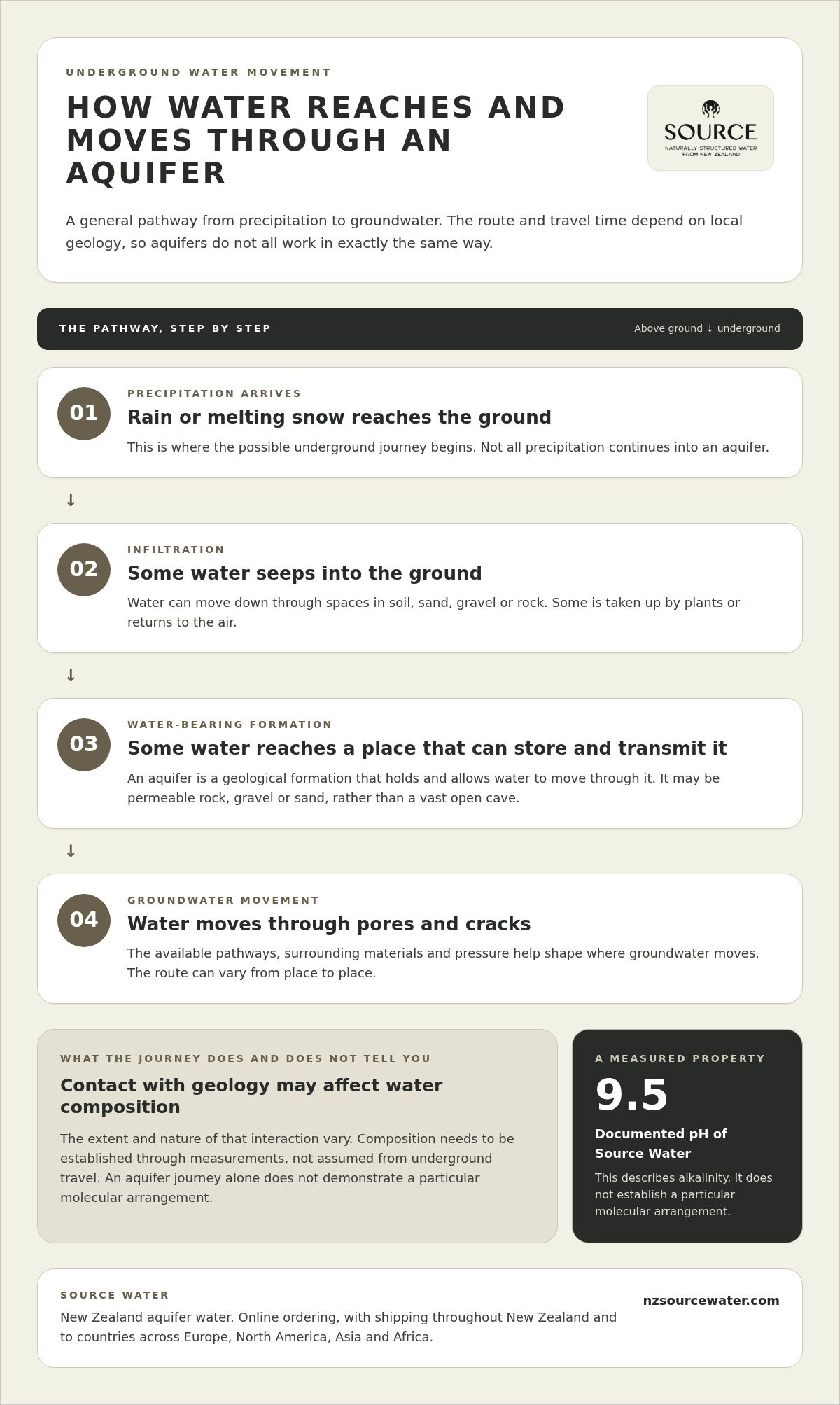
An aquifer’s story begins above ground. Rain or melting snow may seep into the soil, then move down through spaces in soil, sand, gravel or rock. Some water is taken up by plants or returns to the air; some continues underground until it reaches a layer that can store and transmit it. The pathway depends on the local landscape and geology, so it isn’t identical everywhere.
From rainfall to underground water movement
Below ground, water can occupy pores between grains or cracks in rock. An aquifer is not usually an underground lake. It is a water-bearing geological formation through which groundwater can move, often slowly and along routes shaped by the materials and pressure around it. The U.S. Geological Survey describes aquifers as huge storehouses of water, while explaining how groundwater is held and moves through geological materials.
In broad terms, the sequence is:
- Precipitation reaches the ground.
- Some water infiltrates, or seeps into the ground.
- Water may continue down to a water-bearing formation.
- Groundwater moves through available pores and cracks, with its route shaped by local conditions.
This is a general outline, not a map of every aquifer. The specific rock type, route and underground travel time depend on the geology of the place.
What aquifer contact can and cannot establish
As water moves through geological materials, it can interact with them and its composition may be affected. The extent and nature of that interaction vary. Composition is established through measurements, not assumed from the fact that water has travelled underground. The same distinction applies to claims about molecular structure: an aquifer journey alone doesn’t show that water has a particular molecular arrangement.
Source water comes from a New Zealand aquifer and has a measured pH of 9.5. These are distinct facts: the aquifer identifies its origin, while pH describes its alkalinity. Neither fact establishes a specific underground route or molecular behaviour.
In brief: precipitation may infiltrate the ground, groundwater can move through water-bearing geological formations, and local materials may affect its composition. The details vary by aquifer and depend on evidence about that particular place.
Explore this example of water from an aquifer and learn about naturally alkaline New Zealand water.
Natural Aquifer Water, DIY Methods, and Devices: What Is Different?
These approaches describe different things. Natural aquifer water is defined by its geological origin; household practices and purpose-built devices describe actions applied to water. Seeing water swirl, sit in sunlight or pass through equipment doesn’t, by itself, show that its molecular arrangement has changed. To assess a claim about structured water, clarify the method being described and what evidence supports the claimed outcome.
| Approach | What it describes | What you can observe | What evidence would help assess a structure claim |
|---|---|---|---|
| Natural aquifer water | Water held and moving underground through a geological formation. | Its documented origin and measured properties, where these are available. | Clear details about the water tested, the measurement method and whether a proposed molecular arrangement was directly assessed. |
| Household methods | Practices such as swirling or using sunlight, crystals, funnels, copper, light or blenders. | Movement, exposure or contact with an object. | Measurements before and after treatment, using a suitable method that can test the specific structural claim. |
| Purpose-built devices | Equipment intended to treat or alter water through a particular process. | The device’s operation and any measurable changes in water properties. | Independent, clearly described testing of the water before and after treatment, with results relevant to the claim. |
Do swirling, sunlight or household objects make structured water?
These practices appear in wellness discussions as ways people hope to influence water. But a visible whirl, exposure to light or contact with copper or crystals is not proof of a specific molecular change. A change in one measurable property wouldn’t automatically establish a broader claim about structure either. Ask what was measured, how it was measured and whether the result supports the particular claim being made.
How natural sourcing differs from artificial structuring
An aquifer describes where water is held and moves underground. A household practice or device describes a treatment applied to water. These are distinct pathways and can’t be assumed to produce equivalent results. A useful comparison would identify the water tested before and after each method, then use evidence suited to the property being discussed.
Source water is naturally alkaline drinking water from a New Zealand aquifer. Its origin describes how the water is obtained; it is not proof that a proposed molecular mechanism has occurred. If you’re interested in naturally derived aquifer water, explore Source water online.
What Research Can Say About Water Structure, and Where Caution Matters
Research can reveal how water behaves under particular conditions. Showing that the same behaviour occurs in drinking water, or that a proposed explanation applies to it, is a separate step. That distinction matters whenever “structured water” is used as though it describes one clearly defined, verified property.
What exclusion-zone research does and does not show
Research from Professor Gerald Pollack’s lab at the University of Washington has described areas near water-loving, or hydrophilic, surfaces where some dissolved particles are excluded. This observed effect is often called an exclusion zone. Some proponents interpret it as evidence of a more ordered “fourth phase” of water, sometimes associated with the proposed formula H₃O₂. That is an interpretation of observations in a particular setting, not evidence that packaged drinking water has the same properties.
The setting matters. A result near a particular surface in a laboratory concerns the water and conditions studied there. Applying it to a drinking-water product requires direct testing of that product with a method suited to the claim. A proposed model is not a measurement of every water described as structured.
Questions to ask when reading a structured-water claim
Check the evidence behind the wording. These questions can help:
- What was measured? A pH result, for example, answers a different question from a measurement intended to assess molecular arrangement.
- Where and on what sample? Check whether the work tested a laboratory sample, water near a surface, or the same drinking water being discussed.
- What are the limits? Look for an explanation of the method, conditions and uncertainty, rather than a conclusion broader than the evidence.
- What kind of account is being offered? A personal experience may matter to the person describing it, but it isn’t the same as a controlled scientific study.
A useful distinction: documented measurements tell you what was tested and what the result showed; interpretations of “structured water” suggest what that result might mean.
Neither an aquifer origin nor a pH value establishes a molecular model. To explore Source water as naturally alkaline drinking water from a New Zealand aquifer, view Source water online.
Source Water From New Zealand: A Real-World Aquifer Example
A real-world product can help make the distinction between a water’s documented origin and claims about molecular structure more tangible. Source water is naturally alkaline drinking water from an aquifer in New Zealand. Its documented pH is 9.5, a measurement that describes alkalinity. It doesn’t, by itself, show how the water’s molecules are arranged or prove a particular explanation of how structured water is made.
What is documented about Source water
The product facts are straightforward: Source water comes from a New Zealand aquifer and has a documented pH of 9.5. Origin and pH offer two useful points of reference, but they answer different questions. The aquifer tells you where the water comes from; pH tells you about its acidity or alkalinity. Neither should be stretched into a claim about molecular behaviour or health effects.
This distinction is useful whenever a product description brings together a natural setting and scientific-sounding language. Check which statements describe the water’s origin or a measured property, and which interpret what may be happening at a molecular scale.
A gentle next step for readers exploring aquifer water
If you’re curious about the language used for structured water, read product descriptions with the same distinction in mind: identify the documented product facts, then separate them from interpretations. The guide to buying structured water offers a next step for exploring that topic.
Source water can be ordered online through the website, with shipping throughout New Zealand and to many countries worldwide. Explore it as an example of naturally alkaline aquifer water, while keeping those established details distinct from questions about molecular structure.
Keep Exploring Water’s Natural Journey
Understanding how structured water is made begins with separating a water’s journey from claims about its molecular arrangement. An aquifer describes an underground water-bearing formation, while household methods and devices describe treatments. Neither origin, visible movement nor a pH reading alone proves a particular molecular structure. Research into effects such as exclusion zones concerns specific conditions; a laboratory observation doesn’t establish that the same effect applies to every drinking-water product.
Source water offers a clear, documented example: it comes from an aquifer in New Zealand and has a measured pH of 9.5. These details describe its origin and alkalinity, not a confirmed molecular mechanism.
Learn more about this aquifer-sourced drinking water and explore Source water and its New Zealand aquifer origins. Order online for shipping throughout New Zealand and to many countries worldwide.
Frequently Asked Questions
How is structured water made naturally?
There isn’t one established, universal process for making “structured water”, because the term is used in different ways. It may describe water’s natural journey through an environment, or refer to proposed ideas about molecular arrangement. Water can move through soil and geological formations, but that origin alone doesn’t demonstrate a specific structure. When you encounter a claim, check whether it describes where water came from or a molecular effect that was directly measured.
Can structured water form in an aquifer?
An aquifer can hold and transmit groundwater, but its presence doesn’t establish that water has a particular molecular structure. Some discussions propose that water may become more ordered under certain conditions, but an underground journey isn’t proof of that explanation. The water’s properties need to be measured directly, with the method and its limits made clear. Aquifer origin tells you where water comes from; it doesn’t substitute for evidence of molecular arrangement.
Can you make structured water at home?
People use household practices such as swirling water or exposing it to light with the intention of changing it, but those practices don’t by themselves demonstrate a particular molecular structure. Visible movement isn’t evidence that water has acquired a lasting or distinctive molecular arrangement. To support that claim, suitable measurements would need to assess the water before and after treatment. Without such evidence, describe the action taken rather than claiming a proven result.
Does sunlight or swirling make water structured?
Sunlight or swirling changes water’s exposure to light or movement, but neither observation proves a specific molecular change. Research into water near certain surfaces examines particular laboratory conditions, which aren’t automatically equivalent to sunlight exposure or swirling at home. A well-supported claim should identify the water tested, the measurement method and what the results establish.
Is structured water the same as alkaline water?
No. “Alkaline” describes water with a pH above neutral, while “structured water” is used for a range of ideas about origin, treatment or proposed molecular arrangement. A pH measurement doesn’t show how molecules are organised. For example, Source water has a documented pH of 9.5, which describes its alkalinity. That figure does not establish a particular molecular structure.
Does an aquifer make water molecularly structured?
An aquifer holds and allows groundwater to move through geological material. That underground setting may affect water composition, but aquifer origin alone can’t establish a particular molecular arrangement. Such a claim would require direct measurements of the water and a clear explanation of the method and its limitations. Keep evidence about where water comes from distinct from interpretations of how its molecules may behave.
What is known about how Source water is made?
Source water is naturally alkaline drinking water from an aquifer in New Zealand. Its documented pH is 9.5. These facts describe the water’s origin and alkalinity; they do not establish a particular molecular structure. Explore Source water and order online for shipping throughout New Zealand and to many countries worldwide.