

What does a negatively charged zone observed in laboratory water tell us about drinking that water? It’s an important distinction when weighing negative charge water benefits: a measurable physical property and a demonstrated health outcome are not the same thing.
Charge, oxidation-reduction potential (ORP) and exclusion zones can sound like parts of one explanation. They are different concepts, however, and laboratory observations do not by themselves show what happens when someone drinks a particular water.
This article explains what negative charge means in water research, what scientists observed near certain surfaces in laboratory conditions, and what those findings do not establish. Source Water describes its naturally alkaline water, measured at pH 9.5, in terms of negative charge and ORP. Those descriptions are product positioning, not proof of a health effect. Keeping research findings separate from claims about drinking water makes it easier to assess both.
Key Takeaways
- Electrical charge, oxidation-reduction potential (ORP) and pH are different measurements. They are related discussion points, not interchangeable terms.
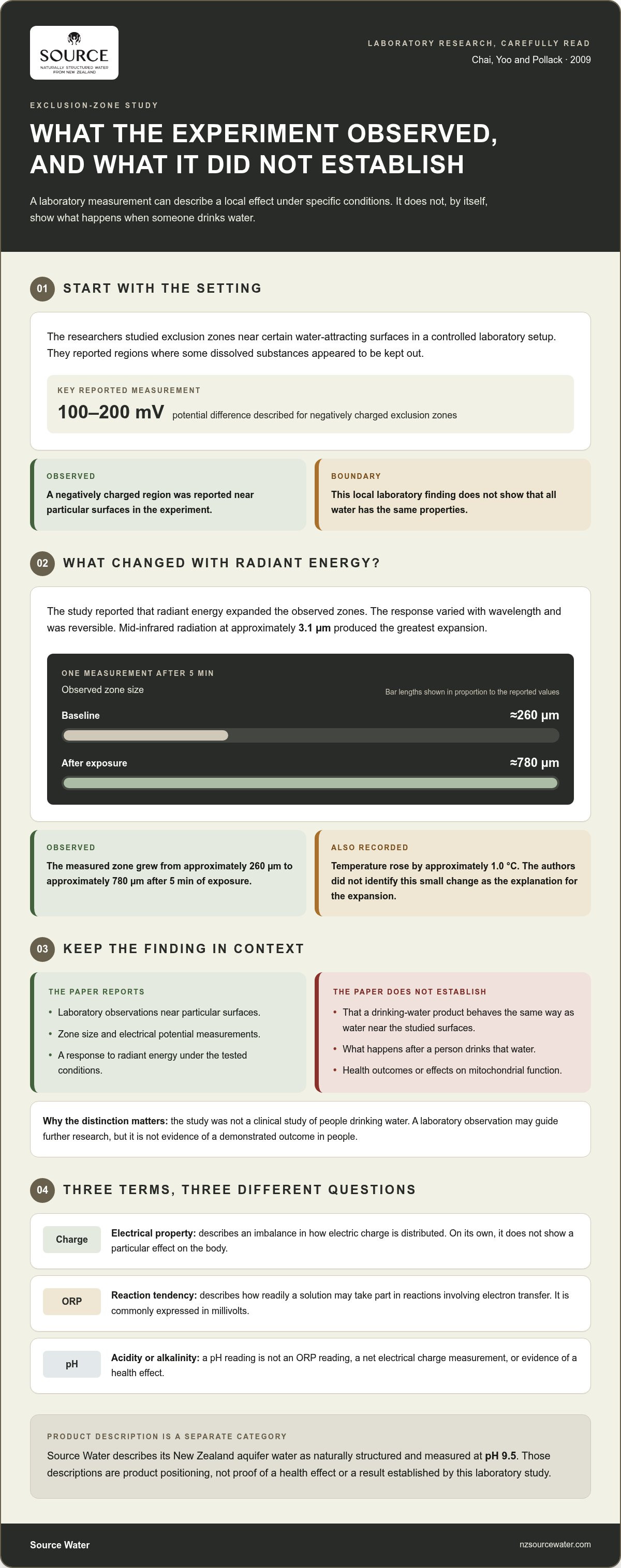
- A 2009 study by Chai, Yoo and Pollack reported negatively charged exclusion zones with potential differences of 100-200 mV in laboratory conditions.
- These findings help explain why people ask about negative charge water benefits, but they do not establish health outcomes from drinking Source Water.
- When assessing a claim, identify whether it describes a measurement, a proposed explanation or an outcome demonstrated in people.
- Source Water is a New Zealand company offering alkaline, structured drinking water from an aquifer. The water is measured at pH 9.5.
What does negative charge mean in water?
A negative charge describes an electrical property, an imbalance in how electric charge is distributed. On its own, it does not show that water will have a particular effect on the body. This distinction matters when considering negative charge water benefits: a physical measurement and a health outcome are different kinds of evidence.
As a simple analogy, think of charge as an electrical balance that can shift one way or the other. It is not a label for water being “better” or more nourishing. Water molecules have their own internal electrical polarity, while a sample of water can still be electrically neutral overall. The conditions and method used to measure a claimed charge also matter.
Negative charge, ORP and pH are different ideas
Negative charge and oxidation-reduction potential (ORP) are related topics in water discussions, but they are not interchangeable measurements. ORP describes how readily a solution may take part in reactions involving the transfer of electrons. It is commonly expressed in millivolts. pH indicates how acidic or alkaline a solution is. Neither pH nor an ORP reading alone tells you that an entire water sample carries a particular net electrical charge, or that drinking it will produce a health effect.
What researchers mean by an exclusion zone
An exclusion zone, often shortened to EZ, is a region observed near certain hydrophilic, or water-attracting, surfaces in laboratory experiments. In that setting, some dissolved substances appear to be kept out of the region. Researchers have described these zones as negatively charged. One proposed explanation links the separation of electrical charges with radiant energy. You can read a general overview of the Exclusion zone (physics) concept and its association with researcher Gerald Pollack.
The experimental setting matters. An observation near a particular surface does not establish that all water has the same properties, that a commercially prepared drinking water behaves in the same way, or what happens after a person drinks it. A laboratory finding about a local region of water is not clinical evidence of a human outcome.
These distinctions help make sense of claims about negative charge water benefits without dismissing the research or treating it as proof. A charge description, an ORP reading, a pH measurement and an effect demonstrated in people each answer a different question.
What does exclusion-zone research actually report?
A frequently cited study by Chai, Yoo and Pollack examined how radiant energy affected exclusion zones near hydrophilic surfaces. Published in the Journal of Physical Chemistry B in 2009, it reported observations from a controlled laboratory setup. The authors described negatively charged exclusion zones with potential differences of 100-200 mV. These measurements add detail to the research, but they do not show that drinking water with similar claimed properties produces a health effect.
What the radiant-energy experiment observed
The researchers reported that radiant energy expanded the observed zones. The response varied with wavelength and was reversible. Mid-infrared radiation at approximately 3.1 µm produced the greatest expansion. In one measurement, the zone grew from a baseline of approximately 260 µm to approximately 780 µm after 5 min of exposure.
The study also recorded a modest temperature rise of approximately 1.0 °C. The authors did not identify that small change as the explanation for the expansion. For readers assessing claims about negative charge water benefits, the distinction is useful: the paper describes a response under particular experimental conditions, not a tested benefit from consuming water.
What the experiment cannot establish
Measurements of a zone’s size or electrical potential are observations. An explanation of how the zone forms is an interpretation, and broader ideas about water’s structure require separate evidence. The experiment does not prove that water forms long-range ordered structures in everyday conditions, or that a drinking-water product has the same properties as water near the surfaces studied.
Nor was this a clinical study of people drinking water. It cannot establish health outcomes or effects on mitochondrial function. An intriguing laboratory effect may guide further research, but it does not by itself demonstrate what happens in the body.
The paper is indexed under DOI 10.1021/jp908163w. It acknowledges National Institutes of Health (NIH) Grants AT-002362 and AR-44813, and Office of Naval Research Grant N00014-05-1-0773. The corresponding author is Gerald H. Pollack, ghp@u.washington.edu, Tel.: (206) 685-1880, Fax: (206) 685-3300. For context on water’s molecular polarity, the American Chemical Society’s Water is a Polar Molecule resource explains how electrical properties can differ within a molecule without proving a health effect.
For a practical point of comparison, Source Water describes its New Zealand aquifer water as naturally structured and measured at pH 9.5. Explore Source Water for product information, while keeping product descriptions distinct from the findings of this laboratory study.
Do negative charge water benefits follow from these findings?
No. A measured property in a laboratory does not, by itself, prove a benefit from drinking water. The exclusion-zone research describes what researchers observed under specific experimental conditions, but it did not test whether drinking Source Water affects health or mitochondrial function.
Keeping observations, interpretations and human outcomes separate makes claims easier to assess:
| Evidence level | What it means | What it can show |
|---|---|---|
| Laboratory observation | Researchers reported negatively charged exclusion zones and changes in their size near hydrophilic surfaces. | Physical behaviour observed in that experimental setup. |
| Proposed interpretation | A battery-like model suggests that separated charges could store energy. | A possible explanation to investigate, not a demonstrated health effect. |
| Demonstrated human health outcome | Evidence would need to show a specific effect in people who drink the product being discussed. | The supplied experiment does not provide this evidence for Source Water. |
Observed findings versus proposed explanations
The reported charge and zone expansion are experimental observations. The battery-like description is a proposed mechanism for interpreting how charge separation might behave. It is an interesting scientific idea, but it should not be presented as a clinical conclusion. The laboratory observations do not establish antioxidant effects, changes to cells, disease prevention or treatment benefits from drinking Source Water.
This distinction is central to evaluating negative charge water benefits. A property measured near a surface in a controlled experiment is not automatically a property with the same role in a bottle or in the body. Each step from laboratory observation to proposed mechanism to personal outcome needs its own evidence.
What would support a health-benefit claim?
A product-specific claim would need evidence relevant to that product and the particular outcome being described. Evidence about a general water phenomenon cannot, on its own, establish what a specific drinking water does in people. The supplied exclusion-zone experiment was not clinical testing of Source Water, and it does not demonstrate medical benefits from drinking water.
If a description moves from “this water has a measured property” to “this water produces a health outcome”, pause and ask what evidence connects those statements. Separating measurement, proposed explanation and demonstrated outcome allows curiosity without treating an intriguing experiment as proof.
How to assess negative charge water claims carefully
Clear wording can help you distinguish a measurable feature from an interpretation or a promise about personal wellbeing. Use these five questions when evaluating claims about negative charge water benefits.
Five questions to ask when reading a claim
- What exactly was measured? Look for the named property and how it was measured, rather than treating “charge” as a complete explanation. Charge, ORP and pH describe different things.
- Where was it measured? Check whether the evidence comes from a laboratory setup, a particular product or people drinking that product. These are distinct settings.
- Does the evidence concern the same product? A finding about water near a hydrophilic surface does not automatically describe a drinking-water product. Look for evidence that relates to the product and the specific claim.
- What outcome is being claimed? Separate a physical measurement from a proposed mechanism, and both from a stated health outcome. A plausible explanation is not the same as an outcome demonstrated in people.
- How certain is the language? Words such as “observed”, “proposed” and “proven” carry different meanings. Notice whether the claim reflects what a study measured, what researchers suggest it could mean, or what evidence has actually established.
This approach does not dismiss new research. It helps you follow the evidence carefully, without assuming that a charge measurement guarantees a personal result or treating drinking water as a means of preventing or treating a health condition.
Where negative charge fits into Source Water’s description
Source Water uses negative-charge language as part of its product positioning. That description is the brand’s perspective, not a verified health effect. The documented product measurement is pH 9.5, which describes alkalinity. It is not a direct measurement of electrical charge and does not establish an outcome for someone drinking the water.
Keeping these details distinct makes it easier to explore a product with informed expectations: note what is measured, understand what the description proposes, and look for evidence before drawing conclusions about health.
For factual product information, explore Source Water’s naturally structured water.
Source Water and a more informed way to explore water
Understanding the limits of a research finding does not mean setting aside curiosity about water. It means considering a product’s description with a clear sense of what is factual, what reflects a brand’s perspective and what has not been demonstrated as a health outcome.
What Source Water’s product information says
Source Water is a New Zealand company offering alkaline, structured drinking water from an aquifer. The water is measured at pH 9.5. This figure describes its alkalinity, not a direct measure of electrical charge, and it should not be read as evidence of a medical effect.
Source Water also uses negative-charge language in its product positioning. The research discussed above does not establish that Source Water has the same measured properties as water in the laboratory experiments, or that it provides a health benefit. The exclusion-zone observations relate to particular experimental conditions.
This distinction gives readers a grounded way to think about negative charge water benefits: a product description can prompt questions, while evidence about a specific health outcome requires more than a research concept or a measurement such as pH.
Explore Source Water at your own pace
If you’re interested in learning more, you can read about Source Water’s water and order online through the website. The company delivers throughout New Zealand and ships to many countries worldwide, including across Europe, North America, Asia and Africa.
Explore the product information at your own pace, with the distinction between documented details and broader claims about water research in mind. Explore Source Water’s structured drinking water.
Explore water with curiosity and clear expectations
Negative charge water benefits are best considered with care: exclusion-zone studies describe physical observations in particular laboratory settings, not proven health outcomes from drinking a water product. Charge, ORP and pH are different measurements, and a finding about one does not automatically establish another.
For any product claim, look for evidence that relates to the specific water and the outcome being described. Source Water is a New Zealand company offering alkaline, structured drinking water from an aquifer, measured at pH 9.5. The brand’s negative-charge positioning is a product description, not a promise of a medical effect.
If you’d like to learn more about the water, you can explore Source Water and order online. Delivery is available throughout New Zealand and to many countries worldwide. Let curiosity guide your choices, with the evidence and product details kept in clear view.
Frequently Asked Questions
What does negatively charged water mean?
It refers to an electrical property measured or described in a particular context, not a guaranteed health effect. In exclusion-zone research, negatively charged describes the region observed near certain surfaces in laboratory experiments. It does not automatically mean an entire water sample behaves the same way, or that drinking it will produce a particular result. Claims about negative charge water benefits should be distinguished from evidence demonstrating outcomes in people.
What is an exclusion zone in water research?
An exclusion zone is a region observed near certain hydrophilic, or water-attracting, surfaces in laboratory experiments. Researchers use the term because some dissolved particles, called solutes, appear to be excluded from that region. The observation describes what happens in a specific experimental setting. It does not mean all water naturally exists in this state, or that a drinking-water product has the same properties or effects.
Did the radiant-energy study prove that drinking negatively charged water has health benefits?
No. The 2009 radiant-energy study by Chai, Yoo and Pollack examined exclusion zones near hydrophilic surfaces in laboratory conditions. It reported that radiant energy expanded the observed zones, but it did not test people drinking water or assess clinical health outcomes. The findings can inform questions about physical behaviour near surfaces, but they do not establish that drinking negatively charged water provides a health benefit.
What did the supplied study report about the charge of exclusion zones?
Chai, Yoo and Pollack reported that the exclusion zones they studied were negatively charged, with potential differences of 100-200 mV. They also described a proton-rich region beyond the exclusion zone. These are findings from experiments near hydrophilic surfaces, not measurements of every water sample or commercial drinking-water product. The reported electrical differences help describe the laboratory observation, but they do not demonstrate a health outcome from drinking water.
Does a water’s pH tell you whether it has a negative charge?
No. pH measures how acidic or alkaline a solution is, while electrical charge is a separate property. A pH result cannot, by itself, tell you whether a water sample has a negative charge or an electrical potential like the exclusion zones described in laboratory research. Read each measurement for what it describes, rather than treating pH, charge and oxidation-reduction potential as interchangeable.
What is Source Water’s measured pH?
Source Water’s water is measured at pH 9.5, a measurement describing alkalinity. Source Water is a New Zealand company offering alkaline, structured drinking water from an aquifer. The pH figure is a product fact, not a direct measurement of electrical charge and not evidence of a medical effect. Consider it separately from laboratory exclusion-zone findings and claims about health outcomes.
Can negative-charge water replace medical treatment?
No. The research described in this article does not show that negative-charge water can replace medical treatment or prevent or treat a health condition. Laboratory observations about water near hydrophilic surfaces are not clinical evidence for drinking a product. If you’re considering a change that could affect your health or treatment, discuss it with a qualified health professional who understands your circumstances. Do not delay or stop care based on a water claim.