

A proposed water structure can be scientifically intriguing without proving a health benefit from drinking it. That distinction is central to understanding structured water benefits: researchers have observed ordered layers of water beside certain surfaces, but this finding alone can’t show that bottled water retains those structures or creates additional effects in the body.
It’s understandable to be curious about claims that connect water’s molecular arrangement with cells, energy and wellbeing. Water is essential to the body, while the further benefits sometimes attributed to structured water remain a separate question, one that calls for clear, relevant evidence.
This article compares commonly claimed effects with what research can and can’t tell us. You’ll learn how ordinary hydration differs from proposed additional benefits, what to look for when assessing studies and product claims, and why laboratory observations don’t automatically demonstrate a health outcome. The aim is a thoughtful, grounded way to consider the claims, without treating any type of water as medical care.
Key Takeaways
- Learn why observations about water near cells don’t automatically prove benefits from drinking structured water.
- Explore which structured water benefits relate to ordinary hydration and which remain proposed or uncertain.
- Use a simple evidence check to distinguish laboratory findings from research involving people.
- Assess water product details separately from claims about health outcomes, including when considering Source Water.
- Discover how to make an informed choice while keeping realistic expectations about what the evidence can show.
What do people mean by structured water benefits?
Curiosity about water’s relationship with living cells is understandable. The language around “structured water”, however, can bring together laboratory observations, proposed explanations and broad wellness promises as though they were one established finding. In this article, structured water benefits are treated as claims to examine: what is being suggested, what kind of evidence would support it, and what remains uncertain.
There isn’t one agreed scientific definition used consistently in wellness discussions. The term may refer to water molecules thought to be arranged in a particular pattern, water near a surface, or water described with labels such as “hexagonal”. These ideas aren’t necessarily interchangeable. Wikipedia’s overview of Hexagonal water outlines the contested use of that term and the criticism of some related marketing claims. The label itself, then, doesn’t tell you what was measured or whether a claimed effect has been demonstrated.
Which benefits are commonly claimed for structured water?
Wellness promotions may suggest that structured water supports “cellular hydration” or greater vitality. Those phrases can sound precise, but a reader should look for a clear description of the outcome and evidence that directly tests it in people. A proposed explanation about how water might interact with cells is not, by itself, proof that drinking a particular water improves hydration or vitality.
This distinction matters because research can examine different things: water’s behaviour beside a surface, a process in cells, or a health outcome in people. A finding at one level may inspire a hypothesis at another, but it can’t automatically answer whether a person who drinks the water experiences the promised benefit.
How do product characteristics differ from health outcomes?
A product characteristic is something that can be measured or described, such as pH, which indicates how acidic or alkaline a liquid is. A health outcome is a separate claim about what happens to someone after drinking it. Measuring a product’s pH doesn’t establish that it changes cellular hydration, boosts vitality or produces another clinical effect.
Think of a label that states a drink’s temperature. That measurement tells you about the drink, not whether it will improve someone’s wellbeing. In the same way, a water measurement can help describe a product, while evidence about a health outcome would need to test that outcome directly. Keeping these questions separate makes it easier to assess claims without dismissing scientific curiosity or mistaking a proposed mechanism for a proven result.
What can research about water and cells tell us?
Research on water inside cells can help scientists understand how water behaves in living systems. But it doesn’t automatically answer a different question: whether drinking water promoted as “structured” produces a measurable benefit. To make that connection, evidence would need to test the drinking-water claim itself, not only describe a process in a cell or laboratory model.
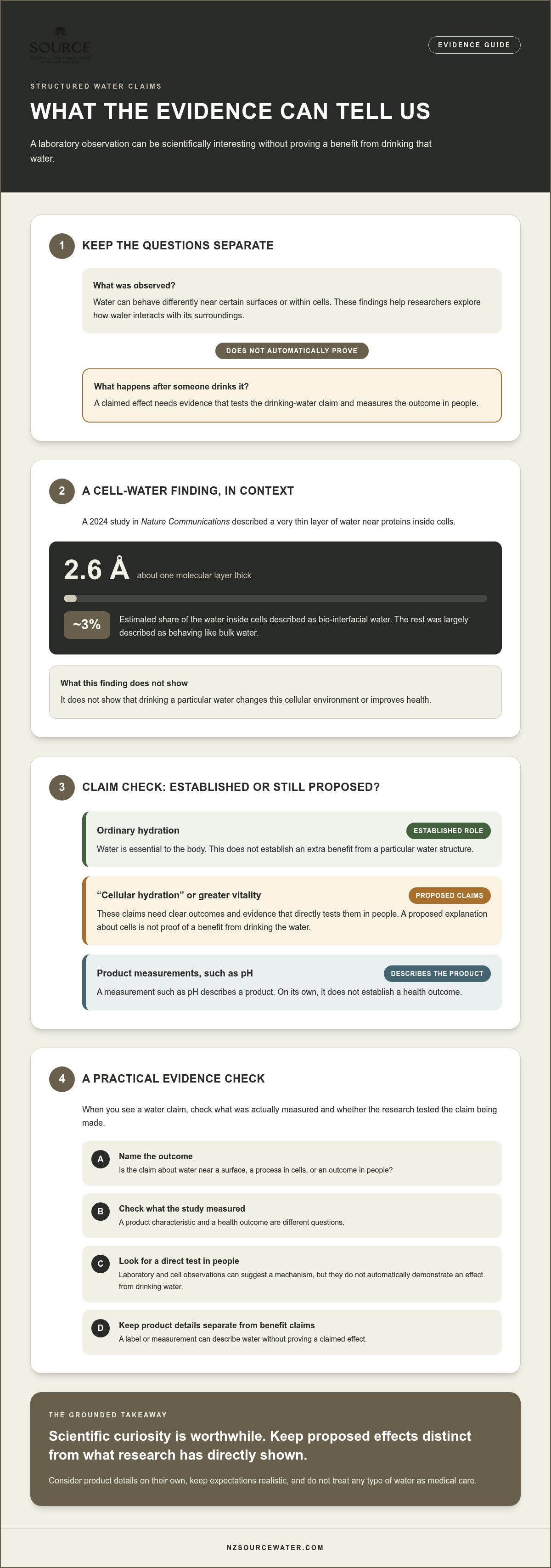
For example, a 2024 Nature Communications study described a thin layer of water near proteins inside cells, about 2.6 Å thick, or roughly one molecular layer. The study estimated that this bio-interfacial water makes up about 3% of the water inside cells, with the rest largely behaving like bulk water. This helps researchers examine water’s local environment, but it doesn’t show that drinking a particular water changes that environment or improves health.
What do cell membranes and aquaporins do?
Cell membranes form boundaries around cells and help regulate what moves in and out. Aquaporins are proteins in these membranes that help water pass through. Think of them as small passageways in a boundary: the comparison helps explain their role, but it’s not a literal description of how they work.
The analogy also has limits. Aquaporins’ role in water movement doesn’t prove that one type of drinking water hydrates cells better. That would require relevant evidence comparing the water types and measuring the claimed effect in people. A useful overview of structured water claims also distinguishes proposed benefits from the limited scientific support for them.
What does exclusion-zone research investigate?
Exclusion-zone, or EZ, water is a research concept describing water near hydrophilic, meaning water-attracting, surfaces. In laboratory settings, researchers have observed areas near these surfaces where some dissolved substances are excluded. These observations can prompt questions about how water and surfaces interact, but they don’t establish what happens after water is swallowed, digested and absorbed.
A laboratory observation can suggest a mechanism, but it isn’t proof of a drinking-water benefit. To support a claim about people, research would need to test the relevant outcome after consumption, rather than infer it from water near a surface or within a cell.
If you’d like to consider a product separately from these scientific questions, you can review Source Water product information and assess its stated characteristics on their own terms.
Structured water benefit claims compared: established, proposed, or uncertain
Evidence is not equally strong for every claim: water’s essential role in normal body function is established, some ideas about water’s behaviour are being investigated, and additional health benefits from drinking commercially described “structured” water remain unconfirmed.
The comparison below separates what hydration research can establish from mechanisms and outcomes that require more direct evidence.
| Claim or question | Evidence status | What this tells us |
|---|---|---|
| Water supports normal body functions | Established | The body uses water in processes including temperature regulation and the movement of substances. These are functions of water generally, not benefits shown to be unique to structured water. |
| Water may form ordered arrangements near certain surfaces | Observed in specific research settings | Laboratory observations can help explain how water behaves at an interface. They don’t establish what happens when people drink the water. |
| Structured water improves cellular hydration or vitality | Unconfirmed as an added drinking-water benefit | A proposed mechanism or product description doesn’t show that people experience these outcomes. Relevant research would need to measure them directly. |
| A product has a particular pH | Measurable product characteristic | A pH reading describes a property of the water. On its own, it doesn’t demonstrate a health effect. |
What can evidence about ordinary hydration establish?
Water is needed for normal body functions, including helping regulate body temperature and transport substances around the body. These roles explain why drinking water matters, but they don’t show that one molecular arrangement provides more hydration than another. Needs can also vary between people and circumstances, so this comparison isn’t a universal daily intake guide or individual health advice.
Which additional effects need stronger evidence?
Claims that structured water enhances cellular processes, energy or general wellbeing go beyond the established role of hydration. Evidence from laboratory models can suggest questions for further study, but it isn’t the same as testing whether people experience a meaningful outcome after drinking the water. Findings in people would need to assess the particular claim directly and account for limitations in how the research was designed.
Uncertainty cuts both ways. A lack of strong evidence for an added benefit doesn’t prove that a product is harmful, but it also can’t be treated as proof that the benefit exists. Similarly, a product measurement, such as pH, describes the water itself; it doesn’t show what effect drinking it has on someone. Keeping those statements separate helps readers weigh structured water benefits without confusing a measurable feature with a demonstrated health outcome.
How can you evaluate structured water benefit claims?
A steady way to assess structured water benefits is to move from the wording of a promise to the evidence behind it. These four checks can help you separate an interesting idea from a demonstrated outcome.
- 1. Identify the exact claim. Is the product said to support hydration, cellular function, energy or another outcome? Specific claims are easier to assess than broad phrases such as “greater vitality”.
- 2. Check what kind of evidence is offered. Does the research involve people drinking the water, or is it an animal study, a laboratory model or an observation of water near a surface? Each can offer different insights, but results from cells or animals don’t establish the same effect in people.
- 3. See whether the study measured the claimed outcome. If a claim is about how people feel, for example, a study needs to assess that outcome in people. A measurement of a product’s properties or a proposed process in a lab can’t stand in for that evidence.
- 4. Look at the methods and limitations. Check who took part, how the comparison was made, and whether the findings have been independently replicated. Small or narrowly designed studies may be useful starting points, but their results shouldn’t be stretched beyond what they measured.
What should readers check in a study?
Read beyond the headline and ask whether the research tested the same water, use and outcome described in the claim. Clear methods make it easier to understand what researchers did and what they found. Replication by independent researchers can add confidence, while limitations help show where uncertainty remains. One result, however interesting, doesn’t settle every question about a product or its effects.
How should evidence inform a personal water choice?
For everyday decisions, consider personal preference alongside access to safe drinking water. A mindful routine can help you pay attention to drinking water through the day, but it shouldn’t be framed as a way to detoxify the body, treat a condition or recover faster. Water is not a substitute for medical care.
If you have a medical condition, have been advised to manage your fluid intake, or are considering changing your care, speak with a qualified health professional. They can help account for your individual circumstances rather than relying on general product claims.
For readers who want to assess a product using these same questions, Source Water’s product details can be reviewed separately from claims about health outcomes. You can view Source Water and order online as a single purchase or recurring subscription.
How to consider Source Water with realistic expectations
After weighing what research can and can’t establish, readers can consider a particular water product on its documented characteristics and their own preferences. Source Water is a New Zealand brand offering naturally structured drinking water. Its product information provides concrete details to review, while questions about structured water benefits should be considered separately from those details.
Which Source Water details are documented?
The water is drawn from an aquifer in New Zealand, and its documented pH is 9.5. These are product characteristics: the first describes where the water comes from, and the second records its pH. Neither detail, by itself, demonstrates a health effect or a change in how cells function.
Source Water is available as a one-off purchase or a recurring subscription. Those options describe how customers can order, not evidence of a particular outcome. Keeping these points distinct can help you decide what matters to you without reading a product feature as a health promise.
How can readers explore the product thoughtfully?
Start with your own preferences and routine. You might consider whether the product information suits what you’re looking for, then look at any health-related statements as separate claims that need their own evidence. Taste and personal preference can inform a water choice, but they shouldn’t be taken as proof of a medical or cellular effect.
Source Water can be ordered online through its website, with shipping throughout New Zealand and to many countries internationally. Delivery specifics aren’t included here, so check the website for current ordering information relevant to your location.
A considered choice doesn’t need to carry more meaning than the evidence allows. If Source Water’s documented details and purchase options align with your preferences, you’re welcome to review Source Water product information and decide for yourself, with realistic expectations and without treating any water as medical care.
Choose with curiosity and clear expectations
Water’s role in ordinary hydration is well established, while proposed extra structured water benefits need evidence that directly tests the claimed outcomes in people. Laboratory observations about water near surfaces or within cells can inspire research, but they don’t by themselves prove that drinking a particular water improves health.
A useful approach is to identify the exact promise, check whether research measures that outcome in people, and consider the study’s limitations. Product characteristics are worth noting too, but they should remain distinct from claims about health effects.
For a practical product comparison, Source Water’s documented details include water drawn from an aquifer in New Zealand, a pH of 9.5, and the choice of a one-off purchase or recurring subscription. These are product facts, not evidence of a health outcome. You can review Source Water product details and decide whether they suit your preferences.
Stay curious, keep claims in perspective, and choose with confidence grounded in what the evidence can actually show.
Frequently Asked Questions
Does structured water have proven health benefits?
Additional health benefits from drinking commercially described structured water haven’t been established by strong human evidence. Research into water near surfaces or within cells can be scientifically interesting, but those observations don’t prove that drinking a product improves health. Ordinary hydration is important for the body, yet claims of extra effects need research that directly tests the claimed outcome in people. Uncertainty doesn’t prove benefit or harm.
Can structured water hydrate you better than ordinary water?
There isn’t strong evidence establishing that structured water hydrates people better than ordinary drinking water. The body needs water, and hydration depends on water intake and individual circumstances, not simply a product’s label or proposed molecular arrangement. To demonstrate a difference, research would need to compare the waters in people and measure relevant hydration outcomes. Laboratory observations or descriptions of a water’s structure can’t answer that question on their own.
What benefits are commonly claimed for structured water?
Claims may include improved cellular hydration, greater energy or vitality, and enhanced wellbeing. These are claims to assess, not established outcomes. Some explanations refer to proposed interactions between water and cells, but a plausible mechanism doesn’t show that people experience the promised effect after drinking the water. Look for research that clearly defines the benefit and measures it in people, rather than relying only on laboratory observations or product descriptions.
Is exclusion-zone water the same as structured water?
Not necessarily. “Structured water” is used in wellness discussions with different meanings, while exclusion-zone water refers to a specific research concept involving water near hydrophilic, or water-attracting, surfaces. Researchers have observed zones near such surfaces where some dissolved substances are excluded. Those observations don’t establish that the same arrangement persists in drinking water or produces health effects after consumption.
Does a water measurement prove a health benefit?
No. A measurement such as pH describes a property of the water, not what happens to someone after drinking it. For example, a pH reading can indicate how acidic or alkaline a sample is, but it doesn’t by itself show improved hydration or another health outcome. To support a health claim, research needs to test that specific outcome directly and report what was measured and the study’s limitations.
Is high-pH water better for hydration?
Higher pH alone doesn’t establish that water hydrates people better. pH describes how acidic or alkaline a liquid is, while hydration is a separate question about the body’s response. A product’s pH can be a useful characteristic to know, but it isn’t proof of a hydration advantage. For a personal concern about fluid intake, particularly with a medical condition, ask a qualified health professional for advice suited to your circumstances.
How can I tell whether a structured water benefit claim is reliable?
Start by identifying the exact benefit being promised, then check whether the evidence directly measures it in people drinking the water. Note whether a study involves people, animals or laboratory models, and review who took part, how the comparison was made and what limitations the researchers report. Independent replication can add confidence. Product measurements and proposed mechanisms may offer context, but they don’t replace evidence of the claimed outcome.