

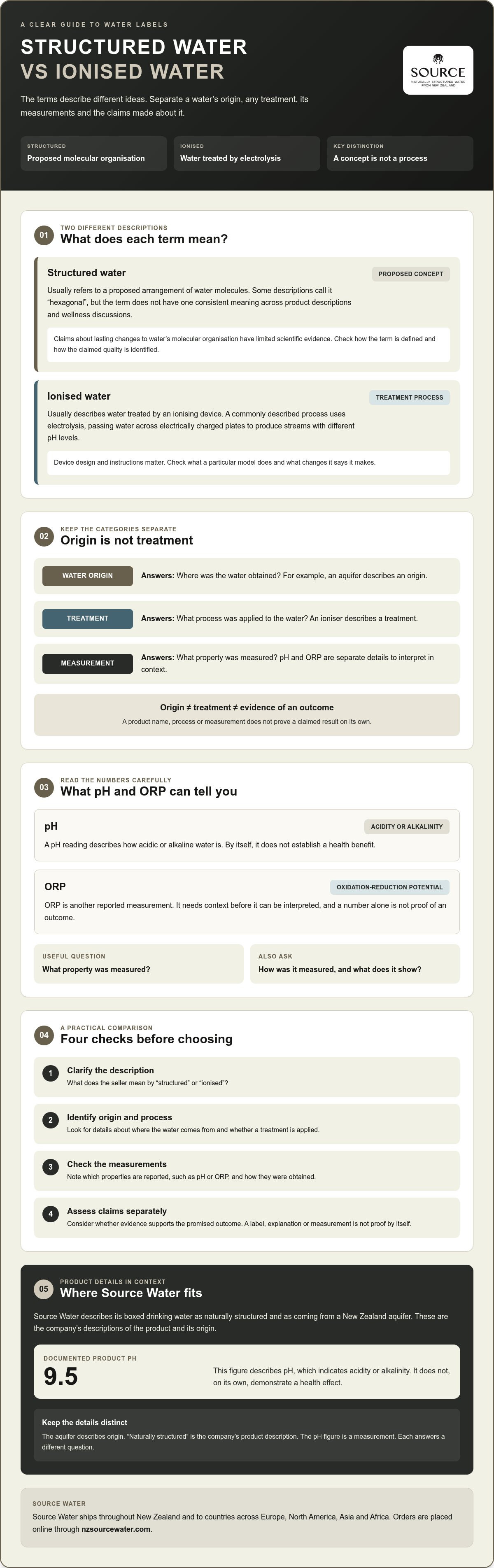
When comparing structured water vs ionized water, the labels point to different ideas. “Structured” refers to a proposed change in molecular organisation, while “ionised” usually describes water treated by electrolysis, which can alter its pH. The terms, measurements and wellness claims can easily blur together.
This guide separates what can be measured from what is being interpreted, so you can assess product descriptions without feeling pressed to buy a particular water or device. A pH reading, for example, tells you about acidity or alkalinity. On its own, it doesn’t establish a health benefit. Claims about structured water also need to be considered in light of the limited scientific evidence for lasting changes to water’s molecular organisation.
We’ll compare how each term is used, outline the processes and measurements commonly associated with them, and look at what the evidence can and can’t tell us. That includes reading details such as pH and oxidation-reduction potential (ORP) in context, rather than treating a label or number as proof of an outcome.
Key Takeaways
- In structured water vs ionized water, the labels point to different ideas: proposed molecular organisation and treatment that changes water’s pH.
- Separate a water’s aquifer origin from any treatment process, then consider measurements such as pH and ORP as distinct details.
- Use pH to understand how acidic or alkaline water is, not as proof of a health outcome. ORP also needs context before it can be interpreted.
- Source Water describes its boxed drinking water as naturally structured, sourced from a New Zealand aquifer, with a documented product pH of 9.5.
- Before choosing, check what a product or device actually does and whether its claims are supported by evidence.
Structured Water vs Ionized Water: What Do the Terms Mean?
In a structured water vs ionized water comparison, the terms describe different ideas, not interchangeable types of water. “Structured” usually refers to a proposed arrangement of water molecules, while “ionised” commonly describes water treated with an ionising device. To assess a product description, keep four questions separate: where the water comes from, whether it has been treated, what measurements are reported, and what those details are said to mean for the body.
What does structured water mean in this comparison?
“Structured water” doesn’t have one consistent meaning across product descriptions and wellness discussions. It may refer to a proposed molecular organisation, sometimes described as hexagonal, but the term needs a clear definition before its claims can be assessed. Hexagonal water summarises the concept and notes that claims associated with it are not supported by established science.
Source Water describes its drinking water as naturally structured. That is the company’s description of the product, not, by itself, evidence that drinking it produces a particular biological or health effect. When you encounter the term elsewhere, check what the seller means by “structured”, how that quality is identified, and whether the supporting evidence relates to the finished drinking water rather than a proposed concept.
What does ionised water mean in this comparison?
“Ionised water” is a product term associated with water treated by an ionising device. In a commonly described process, an ioniser uses electrolysis, passing water across electrically charged plates to produce streams with different pH levels. The device’s design and instructions matter, so check how a particular model works and what it says about its output rather than assuming every device operates identically.
This describes a treatment process and a measurable change, not a demonstrated effect on the body. A higher or lower pH can be recorded, but that figure alone doesn’t show that the water has a health benefit. The same care applies to claims about structured water: a label or explanation of molecular arrangement shouldn’t be mistaken for proof of an outcome.
A practical first step is to identify what kind of comparison you’re making. An aquifer or other natural origin describes where water comes from; an ioniser describes a treatment applied to water. Measurements such as pH or oxidation-reduction potential (ORP) describe particular properties, while biological interpretations are separate claims that need their own evidence.
Look for a plain explanation of the water’s origin or treatment, the relevant measurements, and how they were obtained. Then assess any promised outcome separately. A name, number or process is not proof on its own.
How Water Origin and Ioniser Treatment Differ
Origin and treatment answer different questions. A water’s stated origin tells you where it comes from; an ioniser describes a process applied to water. Neither detail, by itself, establishes a health benefit. Keeping these categories distinct makes it easier to compare product information without treating a natural-origin description and a device’s output as equivalent.
| What you’re comparing | Natural-origin description | Ioniser treatment description |
|---|---|---|
| Main question | Where was the water obtained? | What treatment does the device apply? |
| What to look for | Specific details about the water’s origin, such as an aquifer | The device’s process and the changes it claims to make |
| Measurements | Check which properties are reported, such as pH | Check what properties are measured before and after treatment |
| What it proves | Describes origin, not a health outcome | Describes treatment, not a health outcome |
What can a natural origin tell you?
Source Water describes its boxed drinking water as coming from a New Zealand aquifer and as naturally structured. Its documented product pH is 9.5. These are product details: the aquifer identifies the water’s origin, while pH describes how acidic or alkaline it is. Neither detail alone demonstrates a health effect. For broader context, Healthline critically examines structured water and the evidence behind related claims.
What should readers ask about an ioniser?
Ionisers are commonly described as using electrolysis, with electrically charged plates producing water streams with different pH levels. The exact mechanism and output can vary, so verify the information for the specific device rather than assuming every model works the same way.
Ask what the device claims to change, how that change is measured, and whether the measurement applies to the water you’ll actually use. A measured shift in pH is evidence of a change in that property, not proof of a biological outcome. Keep those claims separate when comparing structured water vs ionized water.
If you’re comparing naturally described drinking water with a device-based approach, first decide whether origin or treatment is the detail that matters to you. You can review Source Water product information to see how the company describes its drinking water and its documented pH.
How to Read pH, ORP, and Health Claims
Measurements can make water descriptions feel precise, but each figure answers a limited question. pH describes how acidic or alkaline a water sample is. ORP, or oxidation-reduction potential, measures the sample’s tendency to take part in oxidation or reduction reactions. Neither number, on its own, tells you whether water will produce a particular effect in the body.
What can pH and ORP measurements show?
pH is one measured property, not a complete assessment of drinking water. Source Water’s documented product figure is pH 9.5. This describes the product’s alkalinity; it doesn’t, by itself, show that the water has a health benefit or establish other qualities such as its mineral content or safety.
ORP readings are often presented in discussions of ionised water, sometimes alongside claims about antioxidant effects. The World Health Organization notes that ORP can help monitor disinfection, but a universal value cannot be recommended because interpretation depends on the circumstances. A reading therefore needs context, including what was tested, how the measurement was taken, and what conclusion the seller draws from it.
A water measurement describes a property, not a health outcome.
How should readers assess health claims?
Start by separating a proposed mechanism from evidence that an outcome occurs in people. A description of how water is treated, a change in pH, or a theory about molecular organisation may explain what is claimed to happen. It doesn’t establish that drinking the water produces a medical or cellular benefit.
Before relying on a product figure, check that it relates to the specific water being discussed and that the measurement method is clear. Measurements can depend on the sample and testing conditions, so a number without that context may be difficult to interpret. Be cautious if a single reading is used to support broad promises about wellbeing.
In a structured water vs ionized water comparison, pH or ORP may help describe measurable properties, but neither resolves whether a health claim is supported. Source Water’s pH 9.5 is product information, not evidence that it treats, prevents, or cures a condition. If you have a medical concern or are considering changing your usual care, speak with an appropriate health professional.
How to Compare Structured Water and Ionised Water Before Choosing
A useful comparison begins with a simple question: are you looking at drinking water described by its natural origin, or a device-based approach that treats water? The labels alone won’t tell you which option suits your preferences, and neither is necessary to make a health or hydration decision. Instead, clarify the description, check the measurements, then assess the evidence behind any promised outcome.
Questions to ask before deciding
Use these checks to compare product or device information:
- Clarify the description. Does it explain where the water comes from, or what treatment a device applies? Ask for a clear definition if a term such as “structured” is left unexplained.
- Check the measurements. Which properties are reported, such as pH or ORP? Do the figures relate to the specific water you’re considering, and does the description explain how and when they were measured?
- Look behind the claim. Is the evidence about a measured water property, a proposed mechanism, or an outcome in people? These are different kinds of information, so one shouldn’t substitute for another.
- Consider practical preferences. Think about whether you prefer to buy drinking water or are interested in a device-based process. Review how each option fits your routine without assuming a label is required for wellbeing.
When a label does not answer your question
Even a clearly explained label can’t determine what’s right for every person. A product’s origin, a device’s process and its reported measurements help describe what you’re comparing, but individual preferences and circumstances still matter. If you have a medical or dietary concern, seek advice from an appropriate health professional rather than relying on wellness claims.
For structured water vs ionized water, make an informed comparison: understand what is being described, check the relevant details, and weigh health claims against suitable evidence. Source Water describes its boxed drinking water as naturally structured and does not sell ionising devices. If you want to explore that natural-origin option, view Source Water’s naturally structured drinking water.
Where Source Water Fits in the Structured Water vs Ionised Water Comparison
With the comparison framework in place, Source Water can be described more clearly: it is boxed drinking water that the company presents as naturally structured, not water treated by an ionising device. “Source Water” is the brand name. Here, the water’s stated origin means where it comes from, not the company itself.
A naturally sourced product, not an ioniser
Documented product information describes Source Water as coming from a New Zealand aquifer at 167 Ararimu Valley Road, New Zealand, and gives its pH as 9.5. These details answer two distinct questions: the aquifer describes the water’s origin, and the pH figure describes a measured property. Neither, on its own, proves a biological or health effect.
That distinction matters in a structured water vs ionized water comparison. Source Water sells drinking water through one-off purchases and recurring subscriptions. It doesn’t sell ionisers or standalone structuring devices, and its product description shouldn’t be read as a claim that the water has been treated by a machine.
Explore the product information before deciding
If you’re considering this option, review the product information and compare its details with the questions raised in this article. Look at what is stated about the water’s origin and measurements, while keeping those product details separate from claims about health outcomes. This allows you to make a considered choice without treating a label as a guarantee of suitability.
Source Water sells online, with orders shipped from New Zealand domestically and internationally. If its naturally structured drinking water is relevant to your comparison, Explore Source Water and review the information before deciding.
Choose with clarity and confidence
The clearest way to approach structured water vs ionized water is to compare what each label describes, then look at measurements and evidence separately. “Structured” and “ionised” refer to different ideas, while pH and ORP readings describe particular properties. Neither a product label nor a measurement alone establishes a health benefit.
Source Water describes its boxed drinking water as naturally structured and sourced from a New Zealand aquifer. Its documented product pH is 9.5, a product detail rather than proof of a health outcome. Customers can choose a one-off purchase or a recurring subscription.
A thoughtful choice begins with clear information, realistic expectations and room to decide what suits your preferences.
Frequently Asked Questions
Is structured water the same as ionised water?
No, structured water and ionised water aren’t automatically interchangeable terms. “Structured water” can mean different things depending on the product or discussion, while “ionised water” usually refers to water associated with an ionising device. Check the explanation for the specific device rather than assuming its process or output. Neither label alone establishes a health effect or shows which option is appropriate for an individual.
Does Source Water sell ionising machines?
No. Source Water sells boxed drinking water that the company describes as naturally structured. Its listed offerings are drinking water available as a one-off purchase or recurring subscription, not water ionisers or structuring devices. This is a distinction between product categories, not a recommendation about using a device. Check a device maker’s own information for details about a particular machine, and assess any health claims separately.
What pH is documented for Source Water?
The documented pH for Source Water is 9.5. pH indicates how acidic or alkaline a water sample is. This figure applies to Source Water’s product information only, not to other waters. It’s a product detail, not evidence of a health benefit. To interpret any pH figure, check which product was measured and look for clear information about the measurement.
Can pH prove that water has health benefits?
No. A pH reading describes one property of a water sample, but it doesn’t prove a medical or cellular benefit. Health claims need suitable evidence beyond a product label or a single measurement. Source Water should not be described as treating, preventing or curing a condition. If you have personal medical questions or are considering changing your care, speak with a qualified health professional.
What does ORP mean when comparing water?
ORP stands for oxidation-reduction potential. In plain language, it’s a measurement related to how a water sample may take part in oxidation and reduction reactions. A reading needs context, including what was tested and how the measurement was taken. ORP alone doesn’t guarantee an antioxidant effect or health outcome, so be cautious of claims that treat a single number as proof.
How should I compare structured water and ionised water claims?
Start by asking what each label means for the specific product or device. Then separate the water’s stated origin or treatment process from measured properties such as pH, and check what sample was tested and how. Assess health statements as separate claims that need suitable evidence. In a structured water vs ionized water comparison, a label or measurement alone can’t settle personal health concerns, so seek qualified advice when needed.