

What if water beside a surface behaves differently from the water around it? Gerald Pollack’s fourth phase water theory begins with observations of water near certain water-attracting materials, where particles appear to be excluded from the region beside the surface. The proposed explanation is intriguing, but these observations do not establish a new phase of water.
If terms such as “exclusion zone” and “interfacial water” make the discussion difficult to follow, you’re not alone. A useful starting point is to separate what experiments measured from what researchers infer those measurements might mean, then ask whether laboratory findings tell us anything about ordinary drinking water.
This article explains the fourth phase concept in plain language, including what exclusion-zone experiments observed and what they did not establish. We’ll look at proposed explanations, including Pollack’s idea of water with a different molecular arrangement, and consider what evidence can and cannot support. By the end, you’ll have a practical way to assess the claims without treating an interesting laboratory effect as proof about the water you drink.
Key Takeaways
- Understand what fourth phase water means and how the term relates to water near water-attracting surfaces.
- Learn what exclusion-zone experiments observed, and why an observed effect does not by itself prove a new phase of water.
- See how radiant energy was tested, including reported wavelength-dependent and reversible changes in exclusion-zone size.
- Use a simple evidence checklist to distinguish laboratory findings from claims about everyday drinking water.
- Discover why Source Water’s measured pH of 9.5 does not establish that it has the properties described by the EZ theory.
What does fourth phase water mean? Understanding the EZ water idea
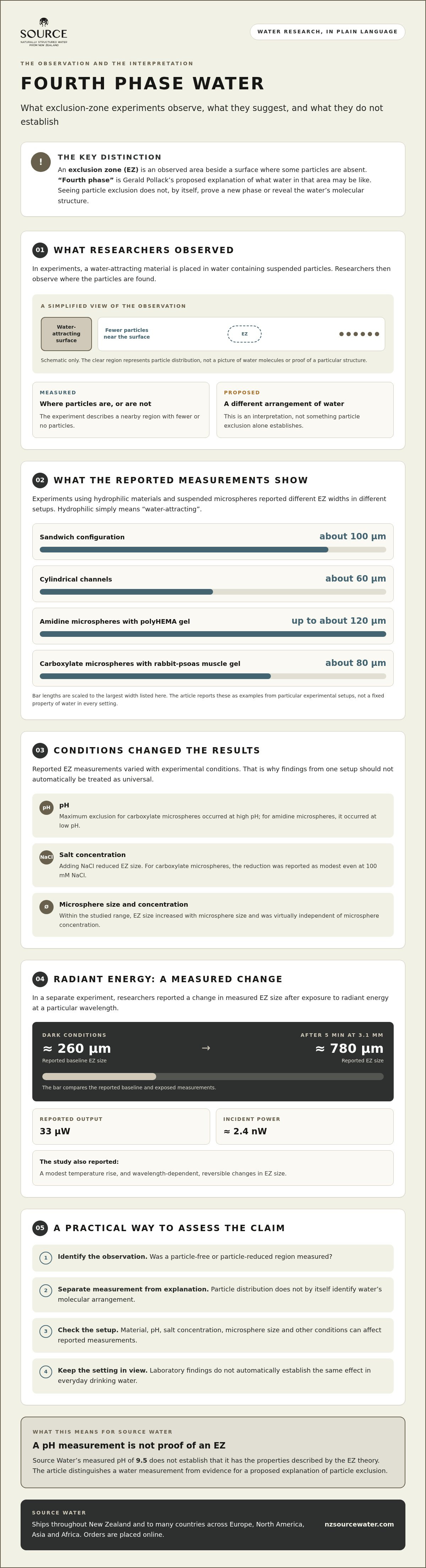
Gerald Pollack uses “fourth phase” to describe his proposal that water next to certain water-attracting surfaces can have an arrangement distinct from ordinary liquid water. In experiments, researchers have observed a nearby region from which some dissolved or suspended substances are absent. This measured region is called an exclusion zone, or EZ.
In brief: The EZ is an observed area of solute exclusion. “Fourth phase” is Pollack’s proposed explanation of what water in that area may be like. The distinction matters: observing a particle-free region does not, by itself, establish a new state of water or reveal its molecular structure.
What is an exclusion zone in water?
In these experiments, researchers place a water-attracting material in water containing small suspended particles, then observe where the particles are located. An area beside the material may contain fewer particles or none. Nafion, a hydrophilic material, has been used in this research. Hydrophilic simply means “water-attracting”. The observation describes the particles’ distribution, not the precise process behind it.
Imagine a clear region beside a surface, with particles gathered farther away. That picture can help visualise the observation, but it is only an analogy. It does not show that water molecules in the region form a particular shape or structure.
Why is it called a fourth phase?
Water is commonly described as having solid, liquid and gaseous states. Pollack’s fourth-phase idea proposes that water near certain surfaces can become sufficiently ordered to be considered another state. This is an interpretation of EZ observations, not an established classification of water. The observed exclusion and the explanation for it need to be considered separately.
The phrase can also appear alongside terms such as “structured water” and “gel water”. These labels are not always used consistently, which can make it harder to tell whether a claim describes an experiment or a broader interpretation. The overview of Hexagonal water discusses the terminology and scientific criticism surrounding these ideas. For a wider introduction, this article’s discussion of structured water offers helpful context.
A careful way to read the term is to treat “exclusion zone” as a description of an experimental observation, and “fourth phase” as a proposed framework for explaining it. The next step is to look at how the experiments are conducted and what their measurements can show.
How hydrophilic surfaces & radiant energy relate to EZ water
Hydrophilic means water-attracting. In laboratory experiments, researchers have placed hydrophilic materials in water containing suspended particles, then observed whether particles remain near the material or are absent from the adjoining region. The measured exclusion-zone size can vary with the material and experimental conditions. These are observations from particular setups, not proof that all water forms a fourth phase or that the same effect occurs in drinking water.
What did the polymer-gel experiments observe?
Experiments with hydrophilic polymer gels reported regions where microspheres were excluded from the area next to a gel. The measured width depended on the setup: reported examples were about 100 µm in a sandwich configuration and about 60 µm in cylindrical channels. Other tested combinations also produced different widths, including up to about 120 µm for amidine microspheres with polyHEMA gel and about 80 µm for carboxylate microspheres with rabbit-psoas muscle gel.
The researchers also reported that pH, salt concentration and microsphere size affected the measurements. Maximum exclusion for carboxylate microspheres occurred at high pH, while maximum exclusion for amidine microspheres occurred at low pH. Adding NaCl reduced exclusion-zone size, although the reduction was modest even at 100 mM NaCl for carboxylate microspheres. Within the studied range, zone size increased with microsphere size and was virtually independent of microsphere concentration.
These results show why experimental details matter. A measurement from one setup cannot automatically be treated as a fixed property of water in every setting. The experiments record where particles are found; they do not, on their own, establish the molecular mechanism behind the exclusion.
What happened when researchers applied radiant energy?
In a separate experiment, researchers measured a baseline EZ size of ≈ 260 µm in dark conditions. After 5 min of exposure to radiant energy at 3.1 µm, its reported size was ≈ 780 µm. The study reported an output of 33 µW and incident power of ≈ 2.4 nW. The measured temperature rise was modest, about 1.0 °C.
In the reported experiment, EZ expansion varied with radiant-energy wavelength. The change was also reported as reversible. Mid-infrared radiation at ≈ 3.1 µm produced the greatest expansion in the study, even at lower incident power than UV-visible wavelengths. The findings describe specific laboratory conditions. They do not establish that radiant energy universally structures drinking water or confirm the proposed molecular explanation. Interpreting the result as energy reorganising water is a hypothesis, distinct from the measured change in EZ size.
To assess this result, ask what material was tested, how the EZ was measured, and whether the conclusion goes beyond those observations. Laboratory findings near a gel or surface do not by themselves describe a packaged drinking-water product. For information about Source water’s naturally structured drinking water, consider its product details separately from EZ experiments.
What does the research show, and what remains a hypothesis?
The evidence is easiest to assess in three layers: what researchers measured, how they interpreted it, and what the results do not establish. Experiments have recorded solute particles being excluded from regions beside particular hydrophilic materials. That observation is meaningful, but it does not by itself confirm a new phase of water or reveal the mechanism behind the effect.
Which findings were directly measured?
In polymer-gel experiments, researchers observed microsphere exclusion next to the tested gels. The measured zone widths varied with the setup and experimental conditions. The mechanism remains unresolved, so the observations should not be treated as proof of a particular force or molecular arrangement.
A radiant-energy study reported that the measured EZ size increased from ≈ 260 µm to ≈ 780 µm after 5 min of exposure to radiant energy at 3.1 µm. Expansion varied with wavelength and was reported to be reversible. These are measurements under specific experimental conditions, not findings about every surface or type of water.
Which explanations are still proposed?
Pollack’s fourth phase water framework interprets EZ observations as evidence of a more ordered state of water. Related ideas, including long-range ordering and a battery-like arrangement, remain proposed explanations rather than established mechanisms. Particle exclusion alone cannot tell us which explanation, if any, is correct.
| Observed measurement | Researchers’ interpretation | What the evidence does not establish |
|---|---|---|
| Microspheres were excluded from regions next to tested hydrophilic gels. | The exclusion may reflect distinctive behaviour or organisation near the gel. | The observation does not identify the mechanism or prove a universally accepted new phase. |
| In the radiant-energy study, the EZ grew from ≈ 260 µm to ≈ 780 µm after 5 min at 3.1 µm; expansion varied with wavelength and was reported as reversible. | Researchers associated the measured change with radiant-energy exposure. | The result does not show that radiant energy structures all water or that the effect applies beyond the tested conditions. |
This distinction matters when laboratory findings are discussed alongside everyday drinking water. These experiments do not demonstrate health effects, and they do not establish that packaged water has the same properties as water studied beside a gel or other test surface. A product description or measurable characteristic cannot, by itself, bridge that evidence gap. Consider claims about fourth phase water in light of the material, conditions and outcome measured, rather than treating them as conclusions about water in general.
How should you assess fourth phase water claims?
Claims about fourth phase water are easier to weigh when you separate what an experiment recorded from what its authors think the result means. A measured change near a particular surface may be interesting, but it does not automatically describe water in other settings, explain the mechanism, or demonstrate an effect on people.
How can you distinguish a result from an interpretation?
Look for concrete measurements, such as the width of an exclusion zone or how it changed under a tested wavelength. Then notice where the language shifts. Words such as “hypothesised”, “suggested” and “proposed” signal an interpretation, not a directly measured fact. Be cautious if a laboratory observation is presented as proof of a biological effect or health outcome.
Laboratory EZ observations do not establish medical benefits. A proposed explanation involving water near a surface is not the same as evidence about health outcomes in people. The laboratory measurements described here do not establish personal health outcomes.
What questions should you ask about an experiment?
Before applying a result more broadly, check what was actually tested. This short checklist can help:
- Material: Which surface or gel was used, and what particles were observed?
- Conditions: How were the samples arranged, and what conditions or variables were changed?
- Measurement: What outcome did researchers record, such as particle exclusion or zone width?
- Interpretation: Which conclusions come from the authors, and which are supported directly by the measurements?
Also check whether the study reports controls and discusses limitations relevant to its conclusions. Most importantly, ask whether the claim concerns water tested beside a laboratory surface or drinking water as it is consumed. Evidence about one setup should not be extended to an unrelated product unless research directly supports that connection.
That distinction matters for packaged drinking water, too. Source Water offers naturally structured, alkaline water sourced from an aquifer in New Zealand, but laboratory EZ observations do not establish that its product has the same properties as water measured beside an experimental surface. If you’d like to review the product information separately from the research, explore naturally structured drinking water. Customers can order online as a one-off purchase or choose a recurring subscription.
How does fourth phase water relate to Source Water?
It helps to keep the laboratory theory and the packaged product in separate categories. Source Water is a New Zealand company that sells naturally structured, alkaline drinking water. Its water is sourced from an aquifer and has a measured pH of 9.5. These are product characteristics, not evidence that the water has the properties described in Gerald Pollack’s fourth phase water theory.
What can be said about Source Water without overclaiming?
In EZ experiments, researchers examine water next to specific materials and measure whether particles are excluded from the nearby region. That setting differs from packaged drinking water. The experiments discussed in this article do not establish that Source Water has an exclusion zone, the molecular arrangement proposed by Pollack, or any particular effect in the body.
Likewise, pH describes how acidic or alkaline a liquid is. A measured pH of 9.5 does not show that water forms a fourth phase, and the product description “naturally structured” should not be treated as proof of the experimental observations. Each statement answers a different question: pH is a measurement, “naturally structured” describes the product, and the fourth-phase idea is a scientific proposal that must be assessed on its own evidence.
This distinction is useful whenever a scientific term appears in product discussions. A finding made beside a laboratory surface cannot simply be transferred to a packaged product because both involve water. Evidence would need to examine the product itself using relevant methods before claims of equivalent properties could be supported. Nor do the EZ observations establish medical benefits.
Where can readers learn about the product?
Source Water is the company’s name, not a reference here to the general idea of where water originates. The company states that its naturally structured, alkaline water is sourced from an aquifer. Customers can order online, either as a one-off purchase or through a recurring subscription. The website provides the product details.
If you’d like to explore the product information with this distinction in mind, visit the Source Water website. The invitation is to learn more about the product; laboratory EZ research and product characteristics remain separate matters.
Carry a clearer understanding into your next water claim
The fourth phase water theory offers one interpretation of a measurable laboratory observation: particles can be excluded from regions beside certain surfaces. That effect is worth examining, but it does not by itself prove a new, universally accepted phase of water or establish health benefits. The experimental conditions, measured results and researchers’ explanations each deserve separate consideration.
That distinction also applies to packaged drinking water. Source water is a New Zealand company offering naturally structured, alkaline water, with a measured pH of 9.5. Those product characteristics do not demonstrate that it has the same properties observed in EZ experiments.
To explore Source water’s product details and online purchase options, visit the Source water website.
Stay curious, ask what the evidence directly shows, and leave room for careful inquiry as the science develops.
Frequently Asked Questions
What is fourth phase water?
Fourth phase water is Gerald Pollack’s proposed description of water near certain hydrophilic, or water-attracting, surfaces. In experiments, researchers have observed an adjoining region where suspended solute particles are excluded, called an exclusion zone or EZ. Pollack interprets this observation as evidence that water there may have a distinct arrangement. The observed zone is measurable, but the proposed phase and its molecular explanation are not established by that observation alone.
Is fourth phase water an established scientific fact?
The experiments described here do not establish fourth phase water as a distinct, universally accepted phase of matter. Water behaving differently near a surface is the subject of the reported research, but that observation does not prove Pollack’s wider interpretation. It is useful to distinguish the measured effect from the explanation proposed for it.
Does radiant energy make an exclusion zone larger?
In a radiant-energy study, researchers reported that an EZ increased from ≈ 260 µm to ≈ 780 µm after 5 min of exposure to radiant energy at 3.1 µm. Expansion varied with wavelength and was reported as reversible. The measured temperature rise was modest, about 1.0 °C. These findings concern a particular experimental setup and do not show that radiant energy universally structures water or drinking water.
Does fourth phase water prove that structured water has health benefits?
No. Exclusion-zone experiments measure physical observations near particular surfaces, not health outcomes in people. The proposed explanations remain interpretations, and the laboratory findings do not demonstrate that drinking structured water provides medical benefits. Assess a health claim separately from a surface-based observation or proposed mechanism.
Is Source water the same as laboratory EZ water?
No. Source water is a New Zealand company offering naturally structured, alkaline drinking water, measured at pH 9.5. That pH does not establish that the product has the properties observed in EZ experiments, which examine water beside specific laboratory surfaces. Customers can order online as a one-off purchase or through a recurring subscription. The product description and laboratory findings should be considered separately.