

What do labels really tell you about mineral-rich water benefits? It’s understandable to wonder when terms such as calcium, magnesium and total dissolved solids appear beside claims about wellbeing. Minerals can influence water’s taste and composition, but their presence alone doesn’t make water medicine or prove a particular health outcome.
To make a more informed choice, start by identifying which minerals are listed and whether their amounts are provided. This guide explains how to read mineral information, assess claims carefully and distinguish mineral content from pH. A high pH or natural origin, for example, doesn’t tell you how much of each mineral the water contains. Keeping these details in context can help you compare water and decide which qualities matter to you, without expecting mineral content to do more than the evidence supports.
Key Takeaways
- Mineral-rich water benefits depend on which dissolved minerals are present and their amounts, not the phrase on a label alone.
- Mineral information describes water’s composition. It isn’t proof that the water prevents or treats a health condition.
- Compare labels by identifying the minerals listed, checking their quantities and noting the serving information.
- Don’t assume terms such as natural, alkaline or artesian reveal how much mineral content water has.
- Keep mineral content, pH and structured-water descriptions distinct when considering Source Water.
What does mineral-rich water mean, and what benefits are people seeking?
Mineral-rich water contains dissolved minerals, such as calcium or magnesium, but the specific mix and amounts vary. The phrase describes a broad composition, not a precise formula. Without a mineral analysis or label that states quantities, it doesn’t tell you which minerals are present or how much is in a glass.
People may look into mineral-rich water benefits because they want to understand its taste and composition, or because they’re interested in the minerals they consume. But minerals in water are only one part of a person’s overall diet. A mineral’s presence doesn’t promise a particular outcome.
It’s useful to distinguish minerals naturally dissolved in water from minerals in food and ingredients added to a drink during processing. These may include the same named substances, but the product information and quantities help show what’s actually in the water. A general overview of mineral water can offer background. The phrase “mineral-rich” alone, however, doesn’t tell you a specific product’s composition.
Which minerals commonly occur in drinking water?
Calcium, magnesium, sodium and bicarbonate are examples of dissolved constituents that may appear in drinking water. Their presence and concentration depend on the water’s composition. These names describe what can be measured, not a guaranteed benefit for every person.
- Calcium and magnesium are mineral names that may appear in a composition listing.
- Sodium is another constituent to look for when comparing the amounts stated on labels.
- Bicarbonate may also be listed as part of the water’s makeup.
Check the quantities, not just the names. Two waters can list the same minerals but contain different amounts.
Is mineral content the same as high pH?
No. pH describes how acidic or alkaline a liquid is. Mineral content describes which dissolved substances it contains and in what amounts. These properties can relate to one another, but pH doesn’t provide a mineral breakdown.
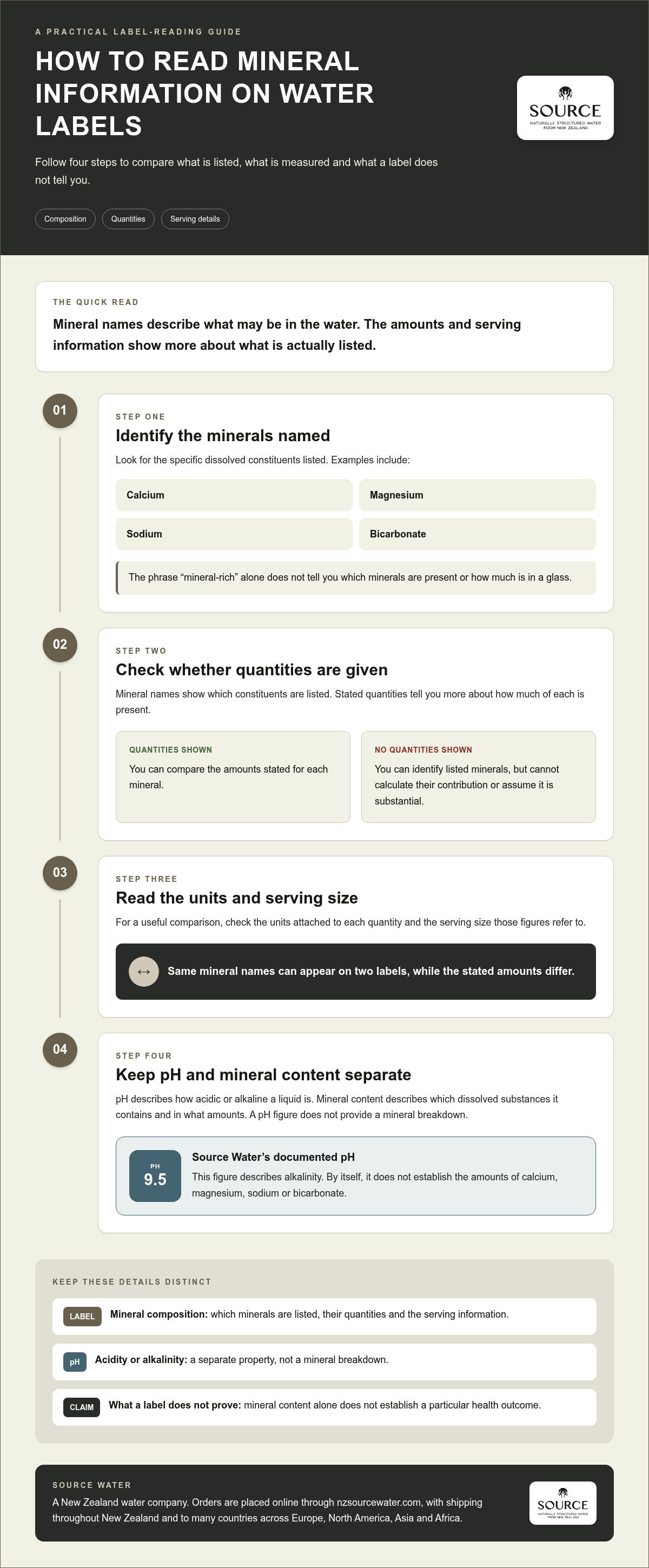
For example, Source Water’s documented pH is 9.5. That figure describes its alkalinity. By itself, it doesn’t establish how much calcium, magnesium, sodium or bicarbonate the water contains. Keeping these details separate makes labels easier to interpret and claims easier to assess.
Mineral-rich water benefits: what minerals may contribute
Water can contribute dissolved minerals to a person’s overall intake, but the amount depends on its composition and how much of that water they drink. A mineral listed on a label isn’t automatically present in a substantial amount, and its presence alone doesn’t show what difference it makes to an individual. Mineral-rich water benefits are best understood as possible contributions to overall intake, not promises that water will prevent, treat or cure a condition.
Overall nutrient intake comes from a person’s wider diet, including the foods and drinks they consume throughout the day. Water may be one part of that picture, but it shouldn’t be considered in isolation. A review of natural mineral waters’ chemical characteristics and health effects discusses variation in mineral-water composition and research on possible effects. Its broader lesson is that composition and evidence matter more than a general label or claim.
Mineral content varies between waters, so read the composition information to see which minerals are present and in what stated amounts. If quantities aren’t given, the term “mineral-rich” alone can’t tell you how much a glass contributes.
Calcium and magnesium in drinking water
Calcium and magnesium may occur in water in dissolved form. To compare two labels, look for each mineral’s stated quantity and note the units and serving size. If a label lists calcium and magnesium but gives no amounts, you can identify their presence, but you can’t calculate their contribution or assume it is substantial. Food remains part of the wider picture.
Sodium and bicarbonate: why composition matters
Sodium and bicarbonate are distinct constituents, not interchangeable benefits. Their names describe different parts of a water’s composition, and their amounts may differ between waters. Rather than relying on the phrase “mineral-rich”, read the stated quantity for each constituent. This gives you a clearer basis for comparison without assigning a health outcome to the label.
For a considered choice, focus on what is measurable: the minerals named, the quantities provided and the serving size those figures refer to. Source Water is naturally structured and alkaline, but those descriptions don’t provide a mineral breakdown. To learn more about Source Water, explore its product information and consider those qualities separately from mineral content.
Does mineral-rich water improve health? Separate evidence from expectation
Mineral-rich water isn’t automatically healthier for every person. Its composition can be described and measured, but a list of minerals doesn’t, on its own, show that drinking the water will improve someone’s health. The mineral-rich water benefits a person might expect depend on which minerals are present, their amounts and the evidence relevant to the specific claim.
Mineral content alone cannot establish a medical outcome. A natural origin or a particular pH doesn’t fill that evidence gap. These details describe characteristics of the water, not proof that it prevents, treats or cures a condition. Separate what can be measured in the water from broader claims about what may happen in the body.
Drinking water can play a role in everyday hydration. The CDC’s overview of the benefits of drinking water provides general context, but hydration benefits shouldn’t be confused with evidence for a particular mineral profile. A claim about a specific mineral needs evidence relevant to that mineral and the outcome being described.
What a mineral label can and cannot tell you
A label may identify constituents such as calcium or magnesium and give measurements for them. This information helps you understand and compare composition, especially when quantities and serving sizes are stated. It doesn’t establish how a particular person will respond or show that the water can treat a health concern. Read label details as information about the water, not as a personal health assessment.
It’s also worth separating a precise composition statement from a broad wellness promise. The first can be checked against stated measurements. The second requires relevant evidence to support the claimed effect. Water’s origin and pH may be useful details, but neither alone proves a health outcome linked to its minerals.
Why individual experiences are not proof
People may describe feeling better after changing what they drink, and their experiences can be meaningful to them. But personal reports can’t show on their own that a particular mineral caused the change. Controlled research is designed to examine effects more carefully and distinguish a possible connection from other influences. For questions about your own health, speak with a qualified health professional rather than relying on water claims or someone else’s experience.
How to assess mineral-rich water: a practical label-reading guide
A clear comparison begins with what’s measurable, not with the promise on the front of a bottle. To assess mineral-rich water benefits without assuming more than the label tells you, follow these steps:
- Identify the minerals listed. Note which constituents are named, such as calcium, magnesium, sodium or bicarbonate.
- Read any quantities provided. Check the units and serving size so you know what the figures refer to.
- Consider the context. Separate composition information from claims about taste, origin, pH or personal wellbeing.
Words such as natural, alkaline and artesian may describe other qualities, but they don’t tell you the amounts of individual minerals. Look for composition details rather than trying to infer a mineral profile from evocative wording.
Which details should you look for on a water label?
Start with the named constituents and any quantities provided by the producer. If a figure is given, note its unit and whether it relates to a stated serving or another amount of water. Labels may present information differently, so focus on understanding the details shown rather than expecting a particular format. If only mineral names appear, you can identify what’s listed, but not how much is present.
How to compare mineral claims fairly
For a useful comparison, look at like-for-like information: the same named minerals, comparable units and the same serving basis where available. A total dissolved solids figure, or TDS, is a broad measure of dissolved material overall. It doesn’t show how much of that total is a particular mineral. Individual mineral measurements provide more specific information. Neither measurement is the same as pH, which describes how acidic or alkaline the water is.
Keep other qualities in their own place, too. Taste, the water’s origin, pH and mineral composition can all matter to your choice, but each describes something different. Don’t treat a natural origin story or a health promise as a substitute for measurable composition information. If alkalinity interests you, a separate guide to natural alkaline water can explore that characteristic without blending it with mineral content.
For a considered choice, begin with the qualities you value and read the available product information in that light. Explore Source Water’s Naturally Structured Water and consider its described attributes separately from mineral-content claims.
A considered perspective on mineral-rich water and Source Water
Choosing water can involve several qualities, each describing something different. Mineral content identifies dissolved constituents and their amounts. Alkalinity describes pH, while “naturally structured” is a separate description of the water. Keeping these attributes distinct makes it easier to understand what a product is without reading a mineral or health claim into details that don’t establish one.
How Source Water’s documented attributes fit this discussion
Source Water is naturally structured, alkaline drinking water drawn from an ancient aquifer in New Zealand. Its documented pH is 9.5, a measure of alkalinity. That figure isn’t a mineral measurement and doesn’t tell you the quantities of individual minerals in the water. Nor does it establish a health outcome. Understand these details on their own terms, without treating them as evidence for mineral-rich water benefits.
If you’d like to explore the product through a different lens, read Buy Structured Water Online: A Considered Guide to Source Water. It focuses on the structured-water description, which is distinct from mineral composition.
Continue exploring water composition and sourcing
Alkalinity is another separate topic. The article Order Alkaline Water Online: A Considered Guide to Source Water offers a place to explore that quality without conflating pH with the amount of dissolved minerals. Together, these topics can help you approach water labels with more clarity: note what is measured, what is described and what the information does not establish.
Source Water is a New Zealand company. You can order its water online through the website, with shipping throughout New Zealand and to many countries internationally. If its documented qualities align with what you’re looking for, explore the product information before deciding.
Choose water with clarity and intention
Mineral-rich water benefits depend on which minerals are present and their stated amounts, so the phrase alone isn’t enough to judge what a water contains. Look for composition details and compare them thoughtfully, without treating mineral content as a guarantee of a health outcome. Remember, too, that pH describes acidity or alkalinity, not the amount of each mineral.
Source Water offers a different set of described qualities: naturally structured, alkaline drinking water from an ancient aquifer in New Zealand, with a documented pH of 9.5. That pH is an alkalinity measurement, not a mineral profile or a health claim. You can order online, with shipping throughout New Zealand and internationally.
If these qualities suit what you’re looking for, explore Source Water and order online. Review the product information and choose based on the qualities that matter to you.
Frequently Asked Questions
Is mineral-rich water better for you than regular drinking water?
Not necessarily. “Mineral-rich” doesn’t identify which minerals are present or how much the water contains, and it doesn’t guarantee a particular health outcome. Compare the stated composition and consider it alongside your overall diet and individual circumstances. If a health condition affects your dietary choices, general information about water isn’t a substitute for advice from a qualified health professional.
Can mineral-rich water provide calcium and magnesium?
It can contain dissolved calcium or magnesium, but the amounts vary between waters. Look for composition information that names each mineral and gives its quantity. The phrase “mineral-rich” alone doesn’t show how much is present or whether a particular water contributes meaningfully to an individual’s nutritional needs. That depends on its measured composition and the wider dietary context.
Does high-pH water mean it is rich in minerals?
No. pH describes how acidic or alkaline water is, while mineral composition describes which dissolved substances are present and their amounts. These are related aspects of water chemistry, but they aren’t interchangeable measurements. A high pH figure alone doesn’t establish a water’s mineral content or nutritional value, and it can’t prove a specific health effect.
How can I tell whether water is mineral-rich?
Look for named minerals and stated quantities in the product’s composition information. Words such as “natural”, “artesian”, “alkaline” or “mineral-rich” don’t by themselves reveal the amount of each constituent. Compare like with like, using the stated units and serving information where provided. An origin story or pH figure isn’t a substitute for measurements of individual minerals.
Can mineral-rich water replace mineral supplements?
Don’t assume it can. Mineral amounts vary between waters, and a broad description can’t establish whether a water meets someone’s individual needs. If you’re considering changing a supplement, particularly because of a health condition or prescribed treatment, discuss that decision with a qualified health professional. A product label can describe composition, but it can’t determine what is appropriate for your personal circumstances.
What is the difference between mineral water and alkaline water?
Mineral water describes water in relation to its dissolved mineral content, while alkaline water describes water by its pH. One term doesn’t automatically establish the other. Water described as alkaline may not have its individual mineral amounts specified by that description. Check composition details separately, and don’t assume either label guarantees a particular health benefit.
Are the benefits of mineral-rich water proven for everyone?
No. A label or composition description can’t prove the same outcome for every person. Any potential dietary contribution depends on the water’s measured mineral content and how it fits into the person’s wider diet. Be cautious of claims that water prevents, treats or cures a condition. For personal health questions, seek guidance from a qualified health professional rather than relying on broad wellness claims.